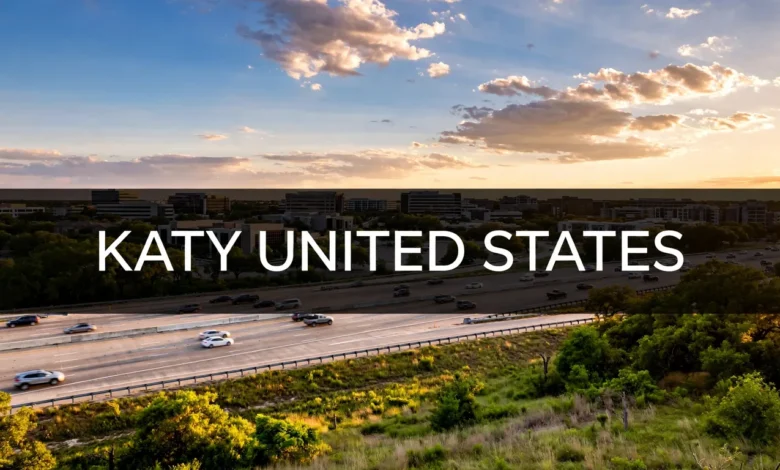
Katy, United States, is a city in Texas, located about 29 miles west of downtown Houston along Interstate 10. It sits at the meeting point of three counties, Harris, Fort Bend, and Waller, and it has grown from a small railroad town into one of the fastest growing suburbs in the Houston area. The 2020 census counted 21,894 people inside the city limits, and later estimates put the population near 27,741 by 2024.
That short answer hides an interesting complication. When most people say “Katy”, they do not mean the small incorporated city. They mean the much larger Katy area, a sprawling patch of suburbs, master planned communities, and unincorporated land that shares Katy mailing addresses. The city itself covers about 14.54 square miles, but the area people call Katy is far bigger. This article explains where Katy, United States, is, how it grew, what it is like to live in or visit, and why the three county line matters more than most newcomers expect.
Where Is Katy, United States?
Katy is in southeast Texas, in the Houston metropolitan area. The city lies along Interstate 10, also known as the Katy Freeway in this stretch, and U.S. Highway 90. Downtown Houston is about 29 miles to the east, and the town of Sealy is about 22 miles to the west. The city is centered almost exactly where Harris, Fort Bend, and Waller counties meet, and its official nickname is “the hub of three counties”.
Its coordinates are roughly 29.79 degrees north and 95.82 degrees west. The city sits on the flat Gulf Coastal Plain, about 141 feet above sea level. The land is mostly flat, with bayous and creeks running through it, and the soil is the heavy clay that much of the Houston area is built on.
The climate is humid subtropical. Summers are long, hot, and humid, with temperatures often above 90 degrees Fahrenheit from June through September. Winters are mild, with most days in the 50s and 60s, though cold fronts can bring short freezes. Rain falls throughout the year, and the area is no stranger to heavy downpours. Hurricanes and tropical storms from the Gulf of Mexico are the biggest weather risk, and flooding is a real concern during major storms.
Katy, United States: The City vs. the Katy Area
The most important thing to understand about Katy is the difference between the city and the area. The City of Katy is a small incorporated municipality. It was formally incorporated in 1945 and covers about 14.54 square miles. About 21,894 people lived inside those limits at the 2020 census.
The Katy area is something else entirely. It includes the city plus a large ring of unincorporated communities and master planned neighborhoods in Harris, Fort Bend, and Waller counties. Places such as Cinco Ranch, Cross Creek Ranch, Firethorne, and Grand Lakes all carry Katy mailing addresses, and their residents say they live in Katy, even though they are outside the city limits. The population of this wider area is estimated at well over 300,000 people.
This distinction matters in daily life. Two houses on the same street can be in different counties, pay different property tax rates, and send their children to different school districts. A Katy mailing address does not tell you which county you are in, which school your children will attend, or which city services you receive. Anyone buying a home in the area should check the exact address against county and school district maps rather than trusting the ZIP code alone.
The main ZIP codes for the Katy area are 77449, 77450, 77493, and 77494. The area codes are 281, 832, and 713, which it shares with the wider Houston region.
Population and Growth in Katy, United States
Katy has grown fast for decades. The census counted 8,068 people in 1990, 11,577 in 2000, 14,121 in 2010, and 21,894 in 2020. Estimates put the city population at about 26,360 in 2023 and about 27,741 in 2024. That is growth of more than 25 percent in four years, and the wider Katy area has grown even faster as new neighborhoods have opened along the Grand Parkway and the Katy Freeway.
Several forces drive this growth. Houston’s Energy Corridor, a major employment center for oil, gas, and engineering companies, sits just east of Katy along Interstate 10, so many energy workers choose Katy for its schools and newer housing. The Katy Independent School District has a strong reputation, which draws families. And the area keeps adding master planned communities with parks, trails, lakes, and shopping built in from the start.
Growth has brought traffic with it. Interstate 10 through Katy is one of the widest highways in the world in places, with as many as 26 lanes including frontage roads, and it still congests at rush hour. The Grand Parkway, State Highway 99, gives drivers a loop around the western side of Houston and has opened up large new areas for development.
A Short History of Katy, United States
Katy began as a railroad town. In 1895, the Missouri-Kansas-Texas Railroad, known as the M-K-T, built a line through the area, and a settlement grew up around the tracks. The town took its name from the railroad’s nickname: railway workers called the M-K-T the “K-T”, and “Katy” was the natural spoken version of those letters. The railroad depot became the center of the new community, and the town grew as a shipping point for local farms.
For much of its early history, Katy was a farming town. Rice was the main crop, grown in the flat fields around the town, and the area also produced cotton and cattle. The Katy Rice Driers and other agricultural businesses served farmers from across the region. The town stayed small for decades, with a few thousand residents at most.
The postwar years changed that. Katy incorporated as a city in 1945, and the construction of Interstate 10 made it an easy commute to Houston. Suburban growth arrived in waves from the 1970s onward, accelerating sharply after 2000 as master planned communities such as Cinco Ranch expanded westward. The old downtown, sometimes called Old Katy, still keeps some of that history alive, with the historic depot, the Katy Heritage Park, and older buildings along Avenue D and First Street.
One of the hardest moments in Katy’s recent history came in August 2017, when Hurricane Harvey stalled over southeast Texas and dropped record rainfall. Large parts of the Katy area flooded, including neighborhoods that had never flooded before, and thousands of homes were damaged. The storm changed how the area thinks about drainage, floodplains, and building, and flood risk is now one of the first things buyers ask about.
Schools in Katy, United States
Schools are one of the main reasons families move to Katy. Most of the area is served by the Katy Independent School District, known as Katy ISD, which is one of the largest school districts in Texas. It operates dozens of elementary, junior high, and high schools, including Katy High School, Cinco Ranch High School, Seven Lakes High School, Tompkins High School, and Jordan High School. Katy ISD schools regularly earn high marks in state ratings, and its high school football teams are famous across Texas.
Part of the Katy area, mainly in Harris County, falls in the Cypress-Fairbanks Independent School District, known as Cy-Fair ISD. A smaller portion is served by Royal ISD in Waller County. Which district serves a given address depends on the exact location, not the mailing address, so parents check the district boundary maps before buying.
Higher education is close by. Houston Community College has a Katy campus, and the University of Houston and other Houston universities are a drive away along Interstate 10.
Economy and Jobs in Katy, United States
Katy itself is mostly residential, but jobs are close. The Energy Corridor, just east along Interstate 10, hosts offices for energy companies, engineering firms, and service companies, and it is one of the biggest employment centers in the Houston area. Many Katy residents work there, in downtown Houston, or in the Texas Medical Center.
Inside Katy, the biggest employers include the school district, the Katy Mills shopping mall, hospitals and medical offices, and the many retail and restaurant businesses along the Katy Freeway and the Grand Parkway. The area has also attracted distribution and logistics businesses because of its highway access.
Shopping is a major local activity. Katy Mills, a large outlet and entertainment mall on the Katy Freeway, opened in 1999 and draws visitors from across the region. LaCenterra at Cinco Ranch is an outdoor shopping and dining center with a central green space that hosts community events. The Katy area also has the usual Texas mix of big grocery stores, home improvement stores, and restaurants along every major road.
Things to Do in Katy, United States
Visitors are often surprised by how much there is to do in a suburb. The list below covers the most popular stops.
Mary Jo Peckham Park is the city’s main park, with a fishing lake, walking trails, a playground, a miniature golf course, and picnic areas. It is a favorite for family weekends.
Katy Heritage Park preserves the town’s history, with restored historic homes and the Katy Heritage Museum. The old M-K-T depot downtown is another reminder of the railroad that created the town.
Typhoon Texas, a large waterpark near Katy Mills, is one of the most popular summer attractions in the Houston area, with slides, a wave pool, and a lazy river.
Central Green Park at LaCenterra hosts concerts, movies, and festivals on its lawn, and the surrounding shops and restaurants make it an easy evening out.
For outdoor lovers, the area has miles of trails. The Cinco Ranch area and the newer communities have extensive hike and bike trail networks, and nearby parks such as Bear Creek Pioneers Park and George Bush Park offer more green space just east of Katy.
Sports matter here too. High school football is a major local event, and the stadiums fill on Friday nights in the fall. The city also has youth sports leagues, golf courses, and fitness centers throughout the area.
Living in Katy, United States: What Newcomers Should Know
People who move to Katy usually come for the same reasons: good schools, newer homes, and a suburban lifestyle within reach of Houston jobs. The housing stock is dominated by single family homes in planned neighborhoods, many built since 2000, with prices that are generally lower than comparable homes inside Houston’s loop.
There are trade offs to weigh. Property taxes can be high, because Texas has no state income tax and local services are funded largely through property taxes. The exact rate depends on the county, the school district, and the municipal utility district, so two similar houses can have noticeably different tax bills. Commuting into Houston can be slow at peak hours, even on a very wide freeway. And flood risk varies by neighborhood, so buyers check flood maps and ask about past flooding before making an offer.
For renters and short term visitors, Katy has hotels along the freeway and around Katy Mills, and it works well as a base for exploring Houston, since downtown is about 30 minutes away without traffic.
How to Get to Katy, United States
Most visitors arrive by car. Interstate 10 runs straight through Katy from Houston in the east to Sealy and San Antonio in the west. The Grand Parkway, State Highway 99, loops around the area and connects to Interstate 10, U.S. Highway 290, and Interstate 69. George Bush Intercontinental Airport is about 45 minutes away by car, and William P. Hobby Airport is about 40 minutes away. There is no passenger train service to Katy, and public transit is limited, so a car is almost essential.
Frequently Asked Questions About Katy, United States
Where is Katy, United States?
Katy is a city in southeast Texas, about 29 miles west of downtown Houston along Interstate 10. It sits where Harris, Fort Bend, and Waller counties meet, in the Houston metropolitan area.
What is the population of Katy, United States?
The 2020 census counted 21,894 people inside the City of Katy. Later estimates put the city population near 27,741 in 2024. The wider Katy area, including unincorporated communities with Katy mailing addresses, has well over 300,000 residents.
Why is Katy, United States, called Katy?
The town is named after the Missouri-Kansas-Texas Railroad, the M-K-T. Railway workers called the line the “K-T”, and “Katy” was the spoken version of those letters. The town grew up around the railroad depot in 1895.
Is Katy, United States, in Houston?
No. Katy is a separate city west of Houston, but it is part of the Houston metropolitan area. Many people who say they live in Katy actually live in unincorporated areas outside the city limits that share Katy mailing addresses.
Which county is Katy, United States, in?
All three. The City of Katy sits at the meeting point of Harris, Fort Bend, and Waller counties. The wider Katy area extends across all three, which is why the city calls itself “the hub of three counties”.
What is Katy, United States, known for?
Katy is known for its highly rated school district, its fast growth, its master planned communities such as Cinco Ranch, the Katy Mills mall, and its Friday night high school football. It is one of the most popular suburbs in the Houston area.
Is Katy, United States, a good place to live?
Many families think so, mainly because of the schools, newer housing, parks, and shopping. The main drawbacks are property taxes, rush hour traffic on Interstate 10, and flood risk in some neighborhoods, so buyers check tax rates and flood maps for the exact address.
What is there to do in Katy, United States?
Popular stops include Mary Jo Peckham Park, Katy Heritage Park and the historic railroad depot, the Typhoon Texas waterpark, Katy Mills mall, LaCenterra at Cinco Ranch, Central Green Park, and the area’s trail networks.
Conclusion: Katy, United States
Katy, Texas, is a small city with a big footprint. Inside its official limits live fewer than 30,000 people, but the name covers a fast growing suburban area of hundreds of thousands, spread across three counties west of Houston. It began in 1895 as a railroad stop named for the “K-T” line, grew as a rice farming town, incorporated in 1945, and then boomed into one of the Houston area’s most sought after suburbs.
For visitors, Katy offers parks, a waterpark, shopping, historic sites, and an easy base for Houston. For people thinking of moving, it offers strong schools and newer neighborhoods, with the trade offs of Texas property taxes, freeway traffic, and flood risk that vary by address. The key point to remember is the one locals always repeat: a Katy address does not tell the whole story. Check the county, the school district, and the flood map for the exact address, and you will know which Katy you are actually dealing with.
Read Also: Inurl:http -Inurl:https: What It Means and How to Use It