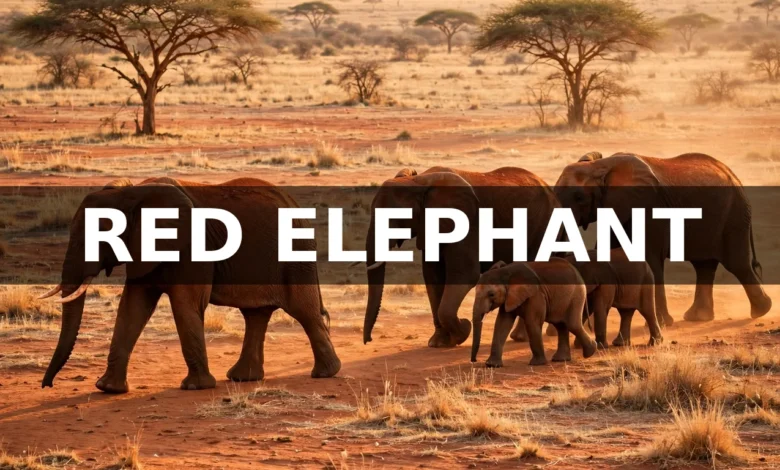
The red elephants of Tsavo are not a different kind of elephant at all. They are ordinary African savanna elephants, Loxodonta africana, covered from head to tail in the iron-rich red soil of Tsavo in Kenya. The colour sits on the skin, not in it, and no elephant is born red. When you see one walking through dry grass with the late light catching its back, the red looks so deep and so even that it is easy to believe it must be natural. It is not. It is dust, mud, and habit, repeated many times a day, and it is one of the most striking sights in African wildlife.
That first sight stays with people. A herd comes down to water in the heat of the afternoon, and instead of the grey you expect, the animals are rust red, brick red, sometimes almost copper in bright sun. The calves are red. The old bulls are red. Even the wrinkles and folds in the skin hold the colour, darker in the creases and lighter where the dust has worn thin on a shoulder or a forehead.
Then the herd steps into the water or a shower passes over, and the picture changes. The red washes away and the grey underneath shows again, plain and familiar. Give it dry weather and a few days of dust-bathing, and the red comes back, just as strong as before.
This guide explains what is really going on, why Tsavo and not somewhere else, how the elephants keep themselves red, where to look for them, and when to plan a visit if seeing them is the reason you are going. It is written for a traveller planning from the United States, with practical detail and no hype, because the elephants themselves are enough.
What Is a Red Elephant?
A red elephant is an African savanna elephant that has coated itself in Tsavo’s red soil. That is the whole secret, and it is worth saying plainly at the start because the name invites the wrong idea. There is no red species, no red subspecies, and no separate population that is born with red skin. Under the dust, a Tsavo elephant is the same grey as an elephant anywhere else in Africa. The red is a layer the animal puts on itself, and keeps putting on, day after day.
The reason the layer looks so complete is the way elephants use their skin. An elephant’s skin is thick and deeply wrinkled, and those wrinkles are not just texture. They trap and hold fine soil. When an elephant throws dust over its back, sprays mud over its sides, or rolls in a damp patch of ground, the red earth settles into every fold. The trunk reaches the places the body cannot reach on its own. The ears flap and settle the dust. The tail flicks and the dust stays. Over the course of a day, the coating builds up until the animal looks painted.
It helps to think of the colour as clothing rather than colouring. It can be washed off. It can wear thin. It can be renewed. A calf that stays close to its mother will pick up the same red coat from the same ground, and will look just as red in a photograph, but the calf was not born that way either. The coat is learned behaviour and local soil, not birth.
That distinction matters for another reason. Visitors sometimes ask whether the red elephants are sick, or stained, or somehow different in health from grey elephants. They are not. The red coat is normal for Tsavo. It is what healthy elephants in this place look like for much of the year. If anything, a dull, patchy coat after rain tells you more about the weather in the last few days than about the animal. The elephant underneath is the same animal, with the same needs, the same social life, and the same place in the herd.
What makes Tsavo special, then, is not the elephant. It is the ground under the elephant’s feet. The soil here has the colour and the texture to make this coating possible, and the climate gives the elephants long dry stretches in which to keep renewing it. Put the same elephant on pale sand somewhere else, and the trick would not work in the same way. The red elephant is a meeting point between an animal, a soil, and a dry season.
Why Are Tsavo’s Elephants Red?
The red comes from iron oxide in Tsavo’s laterite and volcanic soil. Iron oxide is the same family of mineral colour that gives rust its colour and red earth its warmth, and Tsavo has it in abundance. The ground itself is red in many places, a deep, warm red that shows in dry riverbeds, in tracks, in the dust that rises behind a vehicle, and in the earth that clings to an elephant’s legs after it has walked through a muddy hollow.
Laterite soil forms in warm places where rain and heat have worked on rock over a very long time, leaving iron-rich material behind. Volcanic soil adds its own mineral character. Together they give Tsavo a ground that is not just coloured on the surface but coloured through, so that even the fine dust an elephant throws into the air carries the same red. When that dust lands on damp skin, it sticks. When it lands on dry skin, it settles into the wrinkles and stays there until the next wash or the next roll.
The colour is strongest where the soil is driest and finest. In dry weather the dust is light and easy to throw, and it coats evenly. After rain the ground turns to mud, and the elephants use that too, spraying and smearing it on in thicker patches.
The result can look slightly different from one day to the next, and from one animal to the next. One elephant may be a bright, even rust red after a morning spent dusting. Another may be darker and patchier, with grey showing through on the top of the head or along the back where the sun and the wind have worn the coat thin. Both are normal. Both are red elephants.
It is also worth noting what the red is not. It is not blood, and it is not a stain from food or from a plant. It is not a trick of the light, although light certainly helps. In the low sun of morning and late afternoon, the red deepens and warms, and the elephants seem to glow against the pale grass. At midday the colour can look flatter and dustier, closer to the ground itself. Photographers notice this quickly. The same herd can look like a different herd depending on the hour, and that is part of the pleasure of watching them over a full day rather than in a single quick sighting.
The soil also explains why the red returns so reliably. An elephant does not need to travel far to find it. The ground it walks on, rests on, and feeds around is the same ground it bathes in. The habit is built into daily life. Dust-bathing is not a special event the elephants save for visitors. It is something they do many times a day, as routine as feeding and drinking, and the red coat is the visible result of that routine.
How Dust-Bathing Works — and What It Does for the Elephant
Dust-bathing is simple to watch and easy to underestimate. An elephant picks up dust with the tip of its trunk, curls the trunk back, and blows or tosses the dust over its head, back, and sides. It may use a foot to kick dust up first, or it may break up a dry clod and then throw the fine pieces. After a wallow, the process changes slightly. The elephant sprays muddy water over itself, lets it dry, and then adds dry dust on top, building a layered coat that cracks and flakes as it dries.
Wallow and mud-spray are part of the same habit. An elephant will lie down in a muddy hollow, roll from side to side, and stand up coated. It will spray water and mud with its trunk, reaching the back and the belly, the ears and the legs. It will rub against a tree or a rock to work the coating in and to scratch at the same time. Calves copy the adults, sometimes clumsily, sometimes with great enthusiasm, throwing dust in every direction and covering themselves and each other in the process.
The habit has real work to do. Dust-bathing protects the skin from the sun. Elephant skin can burn, and a layer of soil acts as a screen between the sun and the skin, especially on the back and the head where the sun falls hardest. The same layer repels biting insects and parasites. Flies and other biting insects find it harder to reach the skin through a coating of dust and dried mud, and the elephants clearly seek relief in the act itself, returning to it again and again through the day.
Dust-bathing also helps with cooling. Elephants have few sweat glands, so they cannot cool themselves by sweating the way people do. A coat of damp mud and dust, and the habit of wetting the skin and letting the air work on it, helps the animal manage heat in a hot, dry place.
That cooling point is easy to miss if you only think of dust as dirt. For an elephant, dust is care. It is sun care, insect care, and temperature care, all in one repeated action. The animal is not trying to look red. The red is the side effect of looking after itself in a landscape where red soil is what is available. That is why the behaviour is so regular. An elephant does not dust-bathe once and forget about it. It returns to it many times a day, because the sun keeps shining, the insects keep biting, and the heat keeps building.
Watching this up close, if you get the chance, is one of the best parts of a Tsavo visit. The action is unhurried. An elephant will stand in one place and work through its routine with a focus that is almost meditative. The trunk moves in a steady rhythm. The dust rises and settles. The ears move slowly. There is no rush, and there is no performance. It is daily life, and it is completely absorbing to watch because it is so deliberate.
After rain or a swim, the whole picture resets. Elephants look grey again once the red has washed off, and visitors who arrive just after rain sometimes wonder whether they have come to the wrong place. They have not. The red returns within days in dry weather, as the elephants go back to their routine and the ground dries out. The change is a useful reminder that what you see on any given day depends on the weather in the days before you arrived, and that a Tsavo elephant is always the same animal underneath, grey or red.
Where to See Red Elephants: Tsavo East vs Tsavo West
Tsavo East and Tsavo West together form one of Kenya’s largest protected areas, and both hold red elephants. They are neighbours, and they share the same red soil story, but they feel different on the ground, and it helps to know the difference before you choose where to spend your time.
Tsavo East is the classic red elephant country for most visitors. It is known for open, dry plains, for herds coming to water, and for the Aruba Dam, the Galana River, and the Voi area as places where elephants gather. Aruba Dam is a water point where herds come to drink, and the sight of red elephants against the water and the dry grass around it is one of the defining images of Tsavo. The Galana River runs through the park and draws animals in the dry season, and the Voi area, near the entrance and the town of the same name, is a practical base for watching herds without travelling far into the park.
Tsavo East holds roughly 12,000 elephants, so the chances of seeing elephants here are strong, and the open ground makes them easier to spot at a distance.
Tsavo West is greener and more varied, with springs and woodland and hills breaking up the view. Its best-known red elephant spots are Mzima Springs and the lodge waterholes. Mzima Springs is a clear-water spring where elephants and other animals come to drink, and where the contrast between green water plants, clear water, and red elephants is especially vivid. Lodge waterholes, the water points near places where visitors stay, also draw elephants, often in the quieter hours, and offer a slower, closer kind of watching, where you can sit and wait for the herd to come to you rather than driving to find it.
Neither side is better in a simple sense. The choice depends on what kind of watching you enjoy. If you want wide views and large herds at water, Tsavo East is the natural first choice. If you want springs, shade, and a more wooded landscape with waterholes that reward patience, Tsavo West has its own pull. Many travellers who have the time visit both, and compare the same animal in two different settings, which is a good way to understand how much the landscape shapes what you see.
| Tsavo East | Tsavo West | |
|---|---|---|
| Best-known red elephant spots | Aruba Dam, Galana River, Voi area | Mzima Springs and lodge waterholes |
| Landscape feel | Open, dry plains with wide views | Greener, more varied, with springs and woodland |
| Elephant numbers | Roughly 12,000 elephants in Tsavo East | Part of the wider Tsavo Conservation Area, counted at around 14,000 in a 2021 aerial census |
| Watching style | Herds gathering at water, easy to spot at a distance | Slower watching at springs and waterholes, rewarding patience |
| Good for | A first visit focused on red elephants at water | A second stop, or a visit that pairs elephants with springs and shade |
The numbers in that table are worth pausing on. Tsavo East holds roughly 12,000 elephants, and the wider Tsavo Conservation Area was counted at around 14,000 in a 2021 aerial census. That makes this Kenya’s largest elephant population, and it explains why Tsavo has become the place people think of when they think of red elephants. You are not looking for a rare animal in a small pocket. You are looking at a large, living population in a place that is built for elephants, and the red coat is the sign of that fit between animal and place.
Best Time to Visit Tsavo for Red Elephants
The best viewing is in the dry months, June to October and January to February, when herds gather at water. That timing matters more than almost anything else in planning a trip, because water shapes where elephants go and how easy they are to find.
In the dry months, surface water shrinks. Rivers run lower. Small pools dry up. The water that remains becomes a meeting point, and elephants, like other animals, come to it in the morning and again in the afternoon. That gathering is what makes dry-season watching so rewarding. You can wait at a known water point and watch herd after herd arrive, drink, dust-bathe nearby, and move on.
The red is also at its strongest in dry weather, because the ground is dry, the dust is fine, and the elephants are dust-bathing many times a day without rain washing the coat away.
In wetter times, the picture spreads out. Water is available in more places, so herds do not need to gather at the same points. The ground is softer, the dust is damp, and rain can wash the red off faster than the elephants can put it back on. That does not mean there are no elephants to see, and it does not mean a wet-season visit is wasted. It means the watching is less concentrated, and the red may be less vivid on the day you happen to be there. If the red coat is the reason you are travelling, the dry months are the safer choice.
Within a dry-season day, the early morning and the late afternoon are often the best hours for watching. The light is softer and warmer, the red looks richer, and the elephants are active around water. Midday is hotter and quieter, and many animals rest in shade. That rhythm is worth building your day around. Plan to be out early, rest through the hottest part of the day, and be out again as the light softens. You will see more, and you will see it in better light.
It is also worth allowing more than one day. A single day can give you a wonderful sighting, but elephants move, water levels shift, and weather changes. Two or three days in Tsavo give you a much better chance of seeing herds at water in good light, of watching dust-bathing at close range, and of seeing the red return and change over successive days. If you can, spend your first day learning the water points and the rhythm of the place, and use the following days to return to the spots that worked best.
Practical Tips for Visiting Tsavo
A Tsavo visit rewards preparation, but it does not need complicated gear. The most useful thing you can bring is patience, and the second most useful is a willingness to wait at water rather than rushing from place to place. Elephants come to water on their own schedule. A quiet wait at Aruba Dam or a lodge waterhole will often show you more than a hurried drive, and it gives the elephants space to behave naturally.
Bring sun protection and water for yourself, and dress for heat and dust. The same dry air that makes the red dust so fine also makes the sun strong, and you will be out in it for hours. A hat, sunscreen, and light clothing that covers your arms and shoulders will make the day far more comfortable. Comfortable shoes matter too, because even a short walk on uneven ground in heat is tiring without them.
Binoculars are worth carrying, even if you are watching from a vehicle. They let you follow a herd at a distance, pick out calves staying close to their mothers, and watch dust-bathing in detail without needing to move closer. A camera with a zoom lens helps in the same way, and it lets you keep your distance while still capturing the red in good light. Take pictures in the morning and late afternoon when you can. The low sun brings out the red in a way midday light does not.
Keep a respectful distance from the elephants at all times, and follow the guidance of your driver or guide. Elephants are wild animals, and a herd with calves needs space. Do not try to approach on foot, do not make loud noises to get attention, and do not block a path to water. The best sightings happen when the elephants choose to come closer, not when visitors try to close the gap. A good guide will know where to wait and how far back to stay, and will read the herd’s mood in a way a first-time visitor cannot.
Listen as well as look. Tsavo is not silent. You will hear the low rumble of elephants, the flap of ears, the splash of water, and the sound of dust being thrown. Those sounds are part of the experience, and they tell you where the herd is even before you see it. If you sit quietly at a waterhole, you will often hear the elephants before they arrive.
Pack light, but pack thoughtfully. Water, sun protection, binoculars, a camera, and a layer for the cooler early morning are enough for most days. Leave room in your bag for dust. Everything you bring will collect a fine red film by the end of the day, and that is part of the place. Wipe lenses gently and often, and keep electronics in a bag or a case when you are not using them.
Finally, build in time to simply sit and watch. It is tempting to treat a safari as a checklist, moving from one sighting to the next, but the red elephants reward slower watching. A herd at water, dust-bathing and drinking and moving on, is not a quick photo opportunity. It is a scene that unfolds over an hour or more, and the longer you stay, the more you will notice: the calf copying its mother, the old bull arriving last, the way the red deepens as the dust dries. Give yourself that time.
Red Elephant Facts Worth Knowing
The red elephant story is simple at its core, but it has details that are worth holding on to, because they correct the easy misunderstandings that travel with the name.
First, no elephant is born red. The colour is acquired, not inherited. A newborn calf is grey, and it becomes red only as it starts to dust-bathe and wallow in Tsavo’s soil. That fact alone clears up most of the confusion about red elephants. There is no hidden species. There is a habit, repeated many times a day, in a place where the soil happens to be red.
Second, the colour sits on the skin, not in it. The iron-rich soil coats the surface and settles into wrinkles, but it does not change the skin underneath. Wash the coat away, and the grey shows again. That is why rain and swimming change the look so completely, and why the red returns within days in dry weather. The elephant is not changing colour. It is changing coats.
Third, the soil matters as much as the animal. The red comes from iron oxide in Tsavo’s laterite and volcanic soil, and that soil is what makes the whole sight possible. Without that soil, the same behaviour would produce a different colour, or no strong colour at all. The red elephant is a local story, tied to one place and its ground.
Fourth, dust-bathing is care, not play, although it can look playful, especially in calves. It protects the skin from the sun, repels biting insects and parasites, and helps with cooling in an animal with few sweat glands. When you watch an elephant dust-bathe, you are watching it look after itself. The red is the visible sign of that care.
Fifth, Tsavo East holds roughly 12,000 elephants, and the wider Tsavo Conservation Area was counted at around 14,000 in a 2021 aerial census. That is Kenya’s largest elephant population, and it is the reason Tsavo is the place to go if you want to see red elephants in numbers, not just as a single animal. A large population means more herds, more water points in use, and more chances to watch the behaviour that creates the colour.
Sixth, the best viewing is in the dry months, June to October and January to February, when herds gather at water. That timing is not a minor detail. It is the difference between seeing herds together at a water point and searching across a wide landscape for animals that are spread out. If you plan around water and dry weather, you plan around the elephants themselves.
Seventh, the African savanna elephant is listed as Endangered on the IUCN Red List. That listing is a reminder that the sight is not guaranteed by nature alone. It depends on protection, on habitat, and on the work that has allowed Tsavo’s population to recover after heavy poaching pressure in past decades. Seeing red elephants in Tsavo is a pleasure, and it is also a sign that conservation work has held.
Conservation: How Tsavo’s Elephants Came Back
Tsavo suffered heavy poaching pressure in past decades, and that history is part of why the recovery matters so much. Poaching took a heavy toll, and for a long time the future of the population was uncertain. The fact that Tsavo now holds Kenya’s largest elephant population, with roughly 12,000 in Tsavo East and around 14,000 across the wider Conservation Area in a 2021 aerial census, is not an accident. It is the result of protection and recovery over time, and it is widely seen as a conservation success story.
That success does not mean the work is finished. The African savanna elephant is still listed as Endangered on the IUCN Red List, and that listing reflects pressure that continues across its range. Tsavo’s recovery shows what is possible when a large protected area is held and defended, but it also shows how much depends on keeping that protection in place.
A large population in a large protected area has a better chance than a small population in a fragmented one, and Tsavo East and Tsavo West together form one of Kenya’s largest protected areas, which is part of why the recovery has been able to take hold here.
For a visitor, conservation is not an abstract idea. It is the reason the elephants are there to see. The herds at Aruba Dam, at the Galana River, at Mzima Springs, and at the lodge waterholes are there because the ground they walk on has been kept as elephant country. When you watch a herd dust-bathe and turn red in the afternoon sun, you are watching the result of that protection as much as you are watching an animal’s daily habit.
Visitors can support that work by travelling responsibly. Keep your distance, follow your guide, stay on the tracks and roads where you are asked to stay, and do not disturb animals at water. Those small choices add up across many visitors and many days. They keep the elephants calm, they keep the water points usable, and they keep the experience good for the next person who comes to see the same herd.
The red elephants also have a quiet role in conservation beyond Tsavo. They are a vivid, memorable image, and memorable images help people care. A photograph of a red elephant at water is easy to remember and easy to share, and it carries with it the story of a place that was under pressure and came back. That story matters, because it shows that decline is not the only direction. Recovery is possible, and Tsavo is one of the places where it has happened.
Frequently Asked Questions
Are red elephants a different species?
No. Red elephants are ordinary African savanna elephants, Loxodonta africana, coated in Tsavo’s iron-rich red soil. The colour sits on the skin, not in it, and no elephant is born red. Under the dust, a Tsavo elephant is grey like any other savanna elephant.
Why are Tsavo’s elephants red?
The red comes from iron oxide in Tsavo’s laterite and volcanic soil. Elephants dust-bathe and wallow and spray mud many times a day, and the red soil coats the skin and settles into the wrinkles. The habit protects the skin from the sun, repels biting insects and parasites, and helps with cooling, because elephants have few sweat glands.
Do red elephants stay red all year?
Not always in the same way. After rain or a swim, elephants look grey again once the red has washed off. The red returns within days in dry weather, as the elephants go back to dust-bathing and the ground dries out. The colour is strongest in the dry months, when dust-bathing is most frequent and rain is least likely to wash the coat away.
Where is the best place to see red elephants?
Tsavo East is the classic choice, with Aruba Dam, the Galana River, and the Voi area as places where herds gather at water. Tsavo West is also good, with Mzima Springs and lodge waterholes as places to watch elephants come to drink. Tsavo East holds roughly 12,000 elephants, and the wider Tsavo Conservation Area was counted at around 14,000 in a 2021 aerial census, making it Kenya’s largest elephant population.
When is the best time to visit Tsavo for red elephants?
The best viewing is in the dry months, June to October and January to February, when herds gather at water. Early morning and late afternoon are often the best hours within a day, when the light is softer, the red looks richer, and the elephants are active around water.
Are red elephants endangered?
The African savanna elephant is listed as Endangered on the IUCN Red List. Tsavo suffered heavy poaching pressure in past decades, and its recovery is a conservation success story, but the listing is a reminder that protection still matters. Seeing red elephants in Tsavo depends on the large protected area that Tsavo East and Tsavo West form together.
Conclusion
The red elephants of Tsavo are a simple idea made unforgettable by the place itself. They are ordinary African savanna elephants, coated in iron-rich red soil through a daily habit that protects them from sun and insects and helps them stay cool. The colour is on the skin, not in it. It washes off in rain and returns within days in dry weather. It is strongest when herds gather at water in the dry months, June to October and January to February, at places like Aruba Dam, the Galana River, and the Voi area in Tsavo East, and at Mzima Springs and lodge waterholes in Tsavo West.
If you go, go in the dry season, give yourself more than one day, and spend time waiting at water. Watch the dust-bathing as the care it is, not just as a photo opportunity. Keep your distance, follow your guide, and let the herd come to you.
What you will remember is not just the colour, although the colour is striking. It is the sight of a large, living population, Kenya’s largest, moving through its own landscape in the way it has learned to live there, red in the afternoon sun and grey again after rain, and back to red within days. That is Tsavo, and it is worth the trip.