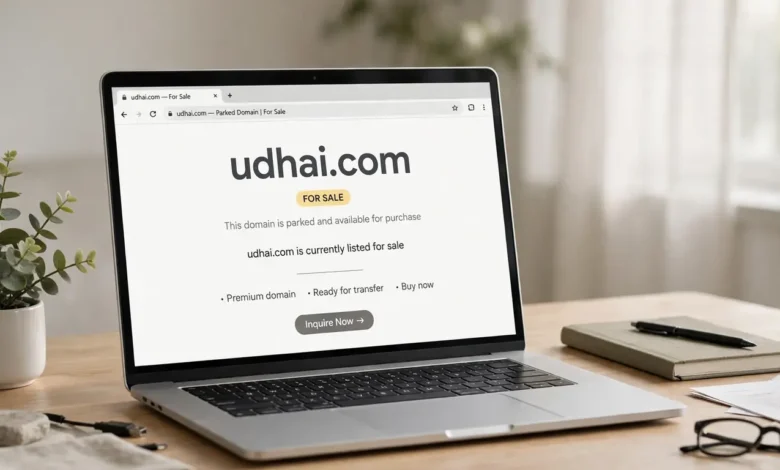
If you’ve landed here after typing “udhai com” into Google, you probably expected to find an actual website — a shop, a service, maybe an app. Here is the short answer before we go any further: udhai.com is not an active website. When we visited the domain directly in October 2026, all we found was a bare landing page announcing that the domain is for sale. There is no store, no app, no login area, and no content to browse. Just a name, sitting parked, waiting for someone to make an offer.
That might feel like a letdown, but it is also useful to know. Every week, people stumble onto parked domains like this one and wonder whether they’ve found a new business, a scam, or something they should be worried about. This guide walks you through exactly what udhai.com is, what the for-sale page offers, how you could contact the owner if you wanted to, and how to judge whether a page like this is trustworthy. We will also clear up the confusion around the word “udhai” itself, because it pops up in a few completely different places.
What Is Udhai.com?
Udhai.com is a parked domain that is currently listed for sale. That’s the whole story as far as anything verifiable goes. We opened the domain in a browser ourselves, and the page is a standard “domain for sale” lander — the kind of placeholder page that domain owners use when they hold a web address they aren’t actively using but would consider selling.
To understand this, it helps to know how parked domains work. Buying a domain name is a little like buying a plot of land. You can hold it, build on it, or simply leave it empty and sell it later if someone wants it. Many domain owners do exactly that: they register names they think might become valuable — short, brandable names like “udhai” are a natural candidate — and park them with a simple for-sale notice. The page generates no business, takes no orders, and collects no customers. It just sits there, visible to anyone who types the address in.
This is worth stressing because the search results around “udhai com” can be misleading. Search engines sometimes guess that you meant something else entirely, or they show you unrelated results with the word “udhai” in them. None of that means there is a hidden website behind the for-sale page. As of our check in October 2026, there is no website at udhai.com beyond the sales lander.
So if you were hoping to sign up for something, buy something, or download something at udhai.com, there is nothing to do there. And if someone told you to visit udhai.com for a deal, a download, or a form — treat that message with caution, because whatever they described, the current page doesn’t match it.
Why Are People Searching for “Udhai Com”?
The honest answer is that nobody knows for sure why a particular person typed it in, but there are a few plausible explanations — and each one matters, because they point to completely different things.
First, the most likely case: someone saw the address written down or heard it spoken and went to look it up. This happens constantly with short domain names. A parked for-sale page is often the end of that trail, which is exactly why people then search the name with a space — “udhai com” — hoping Google will explain what they missed.
Second, “Udhai” is a real name and a real word, so it collides with other meanings. Udhai Mazumdar is a well-known Indian tabla player, music producer, and composer — a disciple of the sitar legend Ravi Shankar — with an established career in Indian classical music. If you came here looking for the musician, the domain for sale has nothing to do with him.
Third, the word “udhai” itself exists in Indian languages. In Gujarati and Marathi dictionaries, udhai (उधई / ઊધઈ) translates to “termite” or “white ant.” It’s one of those words where the same spelling can belong to an insect, a person’s name, and — in this case — a parked domain, all at once. None of these meanings connect to each other.
Finally, there is the typo theory. Plenty of people misremember or mistype domain names, and it’s entirely possible some searches for “udhai com” are aiming at a similarly spelled site — “udai.com,” for example. We don’t have evidence for any specific alternative, so rather than guess, it’s better to say this plainly: if you were trying to reach a specific service, the name you typed doesn’t currently lead to one. Double-check the spelling you were given and search that exact spelling.
What the Udhai.com Landing Page Offers
Since udhai.com is a for-sale lander, “what it offers” is a short list — but let’s be precise about what is actually on the page, so you know what to expect if you visit it yourself.
The page opens with a simple headline: “udhai.com is for sale.” Underneath it sits a short contact form titled “Make an offer (udhai.com).” The form asks for four things: your offer in USD, your name, your email address, and an optional message. Below that, a single reassuring line: “Offers go straight to the owner. Expect a reply within 24 hours.”
That’s it. There is no pricing listed, no “buy it now” button, no catalogue of other domains, and no information about who the owner is. The page doesn’t name a registrar, a marketplace, or a company. It functions as nothing more than a mailbox between a potential buyer and the person holding the domain.
This minimalism is completely normal for parked for-sale pages. The owner wants one thing: serious offers from serious buyers. Everything else — negotiation, payment, the actual transfer of the domain — would happen after that first contact, presumably through whatever sales channel the owner uses.
What the page does not offer is anything worth entering personal details for beyond a genuine purchase enquiry. There is no newsletter to join, no account to create, and no reason to type in passwords or payment details. If you ever see a version of this page that does ask for payment information or logins, you’re looking at a different page than the one we verified — and you should close it.
How to Contact the Owner of Udhai Com
If you’re genuinely interested in buying the domain — perhaps you run a business called Udhai, or you collect short brandable names — the lander gives you exactly one route: the offer form. Here’s how to use it sensibly.
Step 1: Visit the domain and read the page yourself. Pages like this can change hands or change format. Confirm that the for-sale lander is still there and that the form looks like what we’ve described. Never make an offer based on a screenshot someone else sent you.
Step 2: Make a realistic opening offer in USD. The form asks for your offer in US dollars. Short, pronounceable .com domains are not usually cheap, but there’s no listed price here, so your opening number is a starting point for negotiation. Offering one dollar is a good way to be ignored; offering a serious figure is a good way to start a real conversation.
Step 3: Use an email address you actually check. The page promises a reply within 24 hours. If you use a throwaway address, you’ll never see the response. If you don’t hear back, that’s also information — some owners set these pages up and rarely check them.
Step 4: Keep every step after that protected. This is the important part. A legitimate domain sale for a name like this should go through a proper transfer process — ideally with an escrow-style arrangement where your payment is held until the domain actually lands in your account. Never agree to pay by an irreversible method to a stranger just because they replied to your form. A genuine seller will understand your caution; a scammer will pressure you to skip it.
One more honest note: we don’t know who owns udhai.com, and we aren’t going to pretend otherwise. Domain ownership details are often kept private through privacy services, and the lander itself names nobody. The form is the only contact channel the owner has chosen to provide, so it’s the only one we can responsibly describe.
Should You Trust Udhai Com?
Let’s answer the question in the title directly: there is nothing about the udhai.com landing page itself that marks it as a scam — but there’s also nothing on it to actively trust. It’s a neutral page. Here’s the balanced picture.
On the reassuring side, parked for-sale domains are an ordinary, legal part of how the internet works. Thousands of domains sit on pages exactly like this one. The page we verified asks for nothing sensitive — no passwords, no card numbers, no downloads. It doesn’t pretend to be a shop, a bank, or a government service. It says what it is: a domain for sale, with a contact form. There are no wild claims, no countdown timers screaming at you, and no fake reviews. In the world of sketchy websites, that’s a notably quiet page.
On the cautious side, the page gives you no verifiable identity. You don’t know who owns the domain, where they’re based, or what sales channel they’d use. That doesn’t make the owner dishonest — privacy is standard in domain sales — but it means you’re dealing with a stranger from the very first email. Any trust has to be built during the negotiation, not assumed from the landing page.
The real risk with pages like this isn’t the page itself — it’s what happens around it. Scammers sometimes impersonate domain owners, or set up lookalike pages for domains they don’t control. So the practical rule is simple: trust the process, not the page. If you pursue a purchase, insist on a secure, traceable transfer process, keep all communication in writing, and walk away from anyone who rushes you, changes the price mid-conversation, or asks for payment methods you can’t reverse.
And if you’re not trying to buy the domain at all — if you just wanted to know what it was — then the trust question answers itself. There’s nothing to sign up for and nothing to lose. You can simply move on.
Common Scams to Avoid Around For-Sale Domains
Because the main danger around a page like udhai.com lives in the buying process rather than the page, it’s worth knowing the patterns that show up again and again in domain-sale fraud. None of these are accusations about this specific domain — they’re the general warning signs to carry with you anywhere a domain changes hands between strangers.
The impersonator. Someone contacts you claiming to be the owner of a domain you enquired about, but uses a different email address than the one on the official lander. Always reply through the channel the owner actually published. If the “owner” reaches out first from an unrelated address, be sceptical.
The pressure close. “Another buyer is about to pay full price — wire the money today or lose it.” Genuine domain sellers negotiate; they don’t run hostage situations. Urgency is the oldest trick in the book because it stops you thinking.
The irreversible payment. Any request to pay by wire transfer, gift cards, or cryptocurrency to a stranger should end the conversation immediately. Legitimate domain marketplaces hold funds in escrow and release them only when the domain transfer completes. If a seller refuses escrow, they are telling you exactly who they are.
The lookalike page. A scammer copies a for-sale lander onto a slightly different address and collects “offers” — really just harvesting names and email addresses, or worse, upfront “transfer fees.” Always check the address bar character by character before you type anything in.
The fake escrow. A more sophisticated version: the scammer agrees to escrow, then sends you to a fake escrow site they control. Real escrow happens through established, independently verifiable services — ones you navigate to yourself, not through a link in the seller’s email.
None of this means buying a domain from a stranger is impossible — it happens every day, safely, through proper channels. It just means the safety comes from the process you insist on, not from how professional the landing page looks.
Udhai Com Alternatives
Since udhai.com isn’t a functioning service, “alternatives” really depends on what you were looking for in the first place. Let’s cover the likely cases.
If you were looking for the tabla player: search for Udhai Mazumdar by his full name rather than the bare word “udhai.” His official site and established profiles will surface immediately, and you’ll skip the parked-domain dead end entirely.
If you want to buy a domain name like this one: udhai.com is one of countless short, brandable .com names held by investors. If the owner doesn’t reply or the price is out of reach, domain marketplaces list thousands of similar short names — often with transparent pricing and built-in escrow. Searching those marketplaces for short invented or name-based .coms will give you options without the uncertainty of a cold offer.
If you were trying to reach a specific business or app called “Udhai”: go back to where you first saw the name — an advert, a message, a business card — and check the exact spelling and extension. A surprising number of “dead” domain visits turn out to be a misremembered .in, .co, or .org. Searching the exact name plus the industry (“Udhai logistics,” “Udhai app,” whatever fits) usually finds the real thing if it exists.
If you’re just curious about how domains and websites work: this is actually a good rabbit hole. Understanding parked domains, WHOIS privacy, escrow, and transfers will serve you well the next time you buy or sell a web address. We publish plain-English explainers on websites and online topics over on adailyinsight360.com, and you’ll find more practical guides to building and running online sites at homewaterinsights.com — both worth a browse if the mechanics of the web interest you.
Frequently Asked Questions About Udhai Com
Is udhai.com a real website?
Not in the way most people mean it. The domain exists and resolves, but it hosts only a for-sale landing page — no content, no services, no store. It’s a parked domain, not an operating website.
Who owns udhai.com?
We don’t know, and the landing page doesn’t say. Domain owners commonly use privacy protection, so ownership isn’t publicly visible. The only contact the owner provides is the make-an-offer form on the page itself.
Can I buy udhai.com?
Possibly. The page invites offers in USD through its contact form and promises a reply within 24 hours. Whether the owner responds, and at what price they’d sell, is entirely up to them. If you proceed, use a secure escrow-based transfer process.
Is udhai.com a scam?
Based on what we verified in October 2026, no — it’s a standard domain-for-sale lander that asks for nothing sensitive. That said, the page itself gives you no identity to verify, so any purchase negotiation should be handled with the usual caution you’d use with a stranger.
What does “udhai” mean?
It’s a word with several unrelated lives: a personal name (as in the tabla player Udhai Mazumdar), and a Gujarati/Marathi word for “termite” or “white ant.” None of these meanings has anything to do with the parked domain — it’s just a short, brandable string of letters.
Why would someone pay for a domain with nothing on it?
Short .com names are treated like digital property. Buyers want them for future businesses, brand protection, or resale. A parked page is simply the “for sale” sign on that property.
Conclusion
So, to wrap up: udhai com is a parked domain listed for sale, not an active website. The page offers a single thing — a contact form for making an offer in USD — and asks for nothing sensitive in return. It’s an ordinary corner of the domain aftermarket: not a scam in itself, but not something to place blind trust in either, since the owner is anonymous and any real transaction would happen off-page.
If you came here out of curiosity, you now know exactly what sits behind the name. If you came here hoping to buy it, you know the one legitimate channel and the precautions that keep a domain purchase safe. And if you were actually looking for something else entirely — the musician, a business, a differently spelled site — searching the full, exact name will get you there faster than the bare word “udhai” ever will.
Read Also: Narket.com: What Is It, What Does It Offer & Should You Trust It? (2026 Guide)