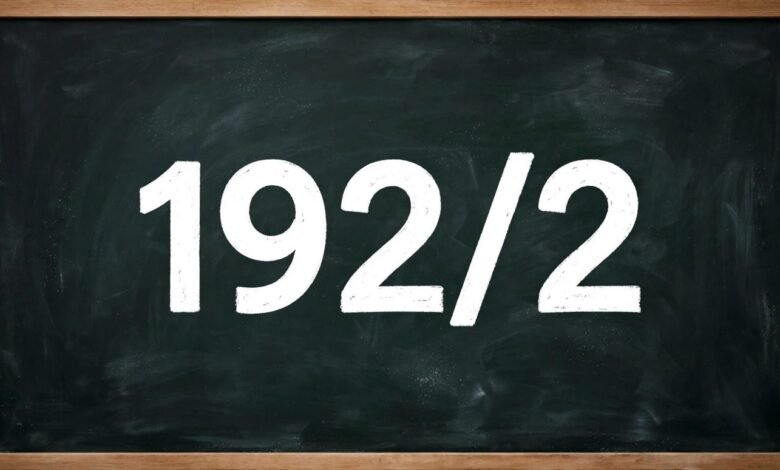
If you typed 192/2 into a search box, chances are you wanted one thing above all else: the answer. Here it is, right up front, so you don’t have to hunt for it.
192 divided by 2 = 96.
That’s it. No tricks, no rounding, no remainder left over. Split 192 into two equal parts and each part is 96. But if you’re here because you want to understand the answer properly — maybe you’re helping a child with homework, checking a calculation, or just curious about why the number works out so neatly — then there’s actually quite a lot worth unpacking. Division is one of those things we all learn young and then mostly hand over to calculators, but knowing how it works by hand makes you faster, more confident, and much less likely to be caught out by a typo in a spreadsheet.
This guide walks through the working step by step, shows a few different ways to get to 96, looks at what 96 actually means in real life, and clears up one common point of confusion: the way 192/2 looks a little like part of a network address, when on its own it really isn’t one.
What 192/2 Actually Asks
Written as 192/2, the expression is a division problem. The number on top (or on the left, before the slash) is the dividend — the amount being split up. The number after the slash is the divisor — the number of equal parts you’re splitting it into. The result is called the quotient.
So 192/2 asks a simple question: if you share 192 equally between 2, how much does each share get?
You can picture it in a few different ways, and all of them lead to the same place:
- Sharing: 192 sweets split between 2 people gives 96 each.
- Grouping: how many groups of 2 fit inside 192? The answer is 96 groups.
- Halving: dividing by 2 is the same as finding half of a number. Half of 192 is 96.
That last point is worth remembering, because it turns any “divided by 2” problem into a halving problem, and halving is something most of us can do in our heads with a bit of practice.
Working It Out by Hand
The long division method
Long division is the method most people were taught at school, and it works perfectly here. The idea is to work through the number one digit at a time, from left to right.
Start with 192. The divisor is 2.
First, look at the first digit, 1. How many times does 2 go into 1? It doesn’t — 1 is smaller than 2 — so we write 0 above it and carry the 1 over to the next digit, making 19.
Next, how many times does 2 go into 19? Nine times, because 9 × 2 = 18. Write 9 above the 9, subtract 18 from 19, and you’re left with a remainder of 1.
Bring down the final digit, 2, next to that remainder, giving 12. How many times does 2 go into 12? Six times exactly, because 6 × 2 = 12. Write 6 above the 2, subtract, and the remainder is 0.
Put the digits together and you get 096, which is simply 96. No remainder, no decimal point, no mess. That clean finish is a good sign: whenever a division ends with a remainder of 0, you know the divisor goes into the dividend an exact number of times.
The halving shortcut
Since dividing by 2 is the same as halving, you can also split 192 into friendlier chunks and halve each one.
Break 192 into 100 + 90 + 2. Then:
- Half of 100 is 50.
- Half of 90 is 45.
- Half of 2 is 1.
Add them back together: 50 + 45 + 1 = 96.
This chunking trick is genuinely useful in everyday life, because it lets you halve numbers without reaching for a phone. It works for any even number: split it into tens and units you find easy, halve each piece, and add the results.
Checking your answer
Every division can be checked by running it backwards. If 192 ÷ 2 = 96, then 96 × 2 should give you back 192. And it does: 96 + 96 = 192. If you ever work out a division and the reverse multiplication doesn’t land back on the original number, something went wrong somewhere, and it’s worth redoing the sum rather than trusting the first answer.
Why 192 Divides So Neatly
Not every number splits in half cleanly. The reason 192 does is simple: it’s an even number. Any number ending in 0, 2, 4, 6, or 8 is even, which means it can be divided by 2 without leaving a remainder. 192 ends in 2, so it’s even, and its half is a whole number.
In fact, 192 can be halved more than once before you run into fractions:
- 192 ÷ 2 = 96
- 96 ÷ 2 = 48
- 48 ÷ 2 = 24
- 24 ÷ 2 = 12
- 12 ÷ 2 = 6
- 6 ÷ 2 = 3
You can halve 192 six times in a row and still land on whole numbers, ending at 3. That’s because 192 is 64 × 3, and 64 is itself a power of 2 (2 × 2 × 2 × 2 × 2 × 2). Numbers built this way break down into small, tidy factors, which is one reason 192 turns up in contexts where things need to be split evenly again and again.
Here’s a quick reference table showing the halving chain:
| Step | Calculation |
|---|---|
| Start | 192 |
| Halve once | 192 ÷ 2 = 96 |
| Halve twice | 96 ÷ 2 = 48 |
| Halve three times | 48 ÷ 2 = 24 |
| Halve four times | 24 ÷ 2 = 12 |
| Halve five times | 12 ÷ 2 = 6 |
| Halve six times | 6 ÷ 2 = 3 |
What 96 Means in Everyday Life
An answer on its own can feel abstract. The number 96 becomes a lot more concrete once you see it in situations you actually meet.
Splitting things fairly
The most common real-world version of 192/2 is sharing something equally between two people. A bill of £192 split between two friends is £96 each. A 192-page book read at the same pace by two study partners means 96 pages each. A playlist of 192 songs divided across two equal halves gives 96 songs per half. Whenever the thing being shared is even and the sharers number two, the maths is exactly this problem.
Halves and pairs
Division by 2 is also the maths behind pairs. 192 items make 96 pairs. In cooking, halving a recipe that serves a large group is the same operation — a recipe written for 192 portions scaled down by half serves 96.
Measurements and distances
Halving shows up constantly in measurement. Half of 192 centimetres is 96 centimetres — just under a metre, roughly the height of a kitchen worktop. Half of 192 minutes is 96 minutes, which is one hour and 36 minutes, a useful conversion if you’re splitting a long journey or a film’s running time into two sittings. Half of 192 grams is 96 grams, a common sort of adjustment when you’re scaling a recipe down.
Money
Money is where most adults actually do division in their heads, and halving is the most common case. Half of £192 is £96. If two people go halves on a £192 hotel room, each pays £96. If a £192 annual subscription is paid in two instalments, each instalment is £96.
Time and schedules
Time is another place where halving matters. A 192-minute event split into two equal sessions gives 96 minutes each.
The Other Reading: Is 192/2 an IP Address?
If you arrived here from a networking angle, you might have wondered whether 192/2 has something to do with IP addresses. It’s a fair question, because the number 192 is famous in networking: many home networks use addresses beginning with 192.168, and network notation often includes a slash, as in 192.168.1.0/24, where the number after the slash describes the size of the network.
But 192/2 on its own is not a valid IP address, and it’s not a complete piece of network notation either. Here’s why, in plain terms:
- A standard IPv4 address has four groups of numbers separated by dots, like 192.168.1.1. “192” alone is only the first group — three groups are missing.
- The slash notation used in networking (called CIDR notation) comes after a complete address, not after a single number. Something like 192.168.1.0/24 is meaningful because the full address comes first; 192/2 has no full address before the slash.
- On its own, 192/2 is simply the arithmetic expression “192 divided by 2”, and its answer is 96.
So if you saw 192/2 somewhere and thought it might be a router address or a network setting, don’t type it into a browser expecting a login page — it won’t get you anywhere. If you’re looking for a router admin page, you need a complete local address, typically something in the 192.168.x.x range, and the exact one depends on your own router and network setup.
Common Mistakes to Avoid
Division by 2 looks easy, which is exactly why slip-ups happen.
Mixing up the order: 192/2 and 2/192 are not the same problem. The second one asks how many times 192 fits into 2, and the answer is a small fraction (2 ÷ 192 = 1/96, roughly 0.0104).
Dropping a digit: when halving in your head, it’s easy to lose track of a tens digit. Writing the number down, or splitting it into chunks as shown above, prevents most of these errors.
Assuming every division is neat: 192 happens to divide by 2 exactly, but that’s because it’s even. An odd number divided by 2 always leaves a half: 193 ÷ 2 = 96.5.
Forgetting to check: the reverse-multiplication check (96 × 2 = 192) takes about two seconds and catches nearly every arithmetic slip.
More Worked Examples
Seeing the same method applied to nearby numbers helps lock it in. Each of these uses the chunking approach: split the number into easy pieces, halve each piece, add the results.
| Number | Split | Halves | Result |
|---|---|---|---|
| 190 | 100 + 90 | 50 + 45 | 95 |
| 192 | 100 + 90 + 2 | 50 + 45 + 1 | 96 |
| 194 | 100 + 90 + 4 | 50 + 45 + 2 | 97 |
| 200 | — | — | 100 |
| 184 | 100 + 80 + 4 | 50 + 40 + 2 | 92 |
| 180 | 100 + 80 | 50 + 40 | 90 |
Notice the pattern: because 192 sits between 190 and 194, its half sits neatly between 95 and 97. Try a few yourself: half of 186 is 93, half of 178 is 89, half of 204 is 102.
FAQ
What is 192 divided by 2? 192 divided by 2 is 96. The division is exact, with no remainder, because 192 is an even number.
How do you work out 192/2 without a calculator? Split 192 into 100 + 90 + 2, halve each part (50, 45, and 1), and add the results: 50 + 45 + 1 = 96.
What is half of 192? Half of 192 is 96. Dividing by 2 and finding half of a number are the same operation.
Is 192/2 the same as 192 ÷ 2? Yes. The slash, the ÷ symbol, and the word “divided by” all mean the same thing here.
Is 192/2 an IP address or a router login? No. On its own, 192/2 is not a valid IP address and not a complete piece of network notation.
What is 192 divided by 2 as a fraction? As a fraction, the problem is written 192/2, which simplifies to 96/1, or just 96.
Conclusion
192/2 equals 96 — a clean, exact answer you can verify in seconds by multiplying back (96 × 2 = 192). Whether you get there by long division, by halving chunks of the number in your head, or by simply remembering that dividing by 2 means finding half, the result is the same, and the method is one you’ll use again and again: splitting bills, scaling recipes, measuring distances, and sharing anything fairly between two people.
And if you came here wondering about the networking angle, the honest answer is just as simple: 192/2 on its own is a maths problem, not a network address.
Read Also: 192.168.8.1 Router Admin Login Step-by-Step (2026 Guide)