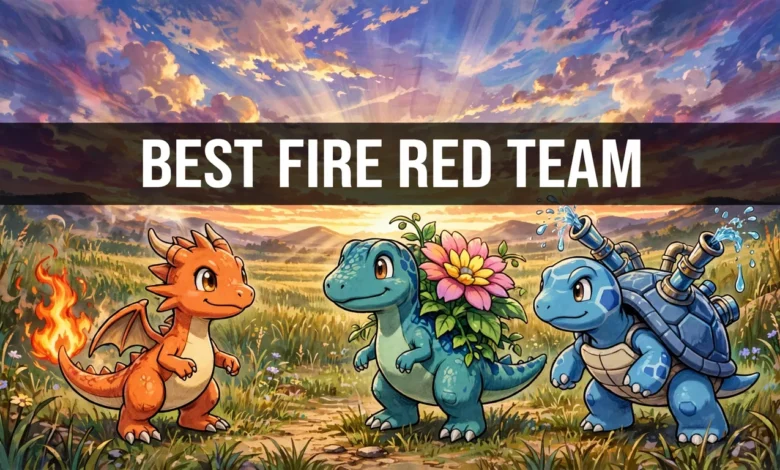
What Is the Best Fire Red Team?
The best Fire Red team is built around your starter, covers as many types as possible, and stays balanced between physical attackers, special attackers, and at least one Pokémon that can take a hit. A strong all-round team looks like this: your fully evolved starter, Alakazam, Gengar, Dragonite, Snorlax, and Lapras or Jolteon, with Zapdos as a powerful late-game option if you want it.
That is the short answer. The longer answer matters more, because the “best” team in Pokémon FireRed depends on which starter you picked, how you like to play, and whether you are building for the story, the Elite Four, or both. FireRed is not a hard game — almost any team can beat the story if it is levelled well — but a team with good type coverage, sensible movesets, and no glaring weaknesses makes the whole journey smoother, especially against the Elite Four and Champion Blue at the end. That is why choosing the best Fire Red team matters.
This guide walks through exactly how to build that team. You will find the best individual Pokémon in the game, where to catch each one in Kanto, what role it plays, three ready-made teams (one for each starter), movesets worth teaching, levelling tips, and a battle plan for the Elite Four. Use it to build the best Fire Red team for your playthrough.
How to Pick a Starter and Build Around It
Your starter is the first big decision in FireRed, and it shapes your team more than any other choice. Professor Oak offers you Bulbasaur, Charmander, or Squirtle in Pallet Town, and your rival takes the one with the type advantage over yours. There is no wrong pick, but each starter creates a different early game and leaves a different gap for the rest of your team to fill.
Charmander: The Hard Start, the Strong Finish
Charmander is the toughest starter to begin with. Brock’s Rock-type Gym is a nightmare for a Fire-type, and Misty’s Water-type Gym is not much kinder. But if you push through, Charizard is one of the best Pokémon in the game: fast, hard-hitting, and with a Fire/Flying typing that gives it useful resistances and the ability to learn Fly. Pick Charmander if you like a challenge early and a payoff late. You will want a Water-type or a Grass-type on your team fairly early to cover the first two Gyms.
Squirtle: The Safe, Steady Choice
Squirtle is the easiest starter for the early game. It handles Brock comfortably and holds its own against Misty, and Blastoise grows into a bulky, reliable Water-type that can learn Surf, Ice Beam, and other strong moves. If this is your first time playing FireRed, or you just want a smooth run, Squirtle is the sensible pick. Its main weakness is a lack of early offensive punch — Blastoise hits solidly but rarely sweeps — so pair it with a fast special attacker like Alakazam or Jolteon.
Bulbasaur: The Easy Start That Stays Useful
Bulbasaur makes the first two Gyms almost trivial, thanks to its Grass typing, and Venusaur stays useful all game with strong Grass and Poison moves, good bulk, and access to Sleep Powder and Leech Seed. It is the only starter that is strong against the first two Gym leaders, which makes the opening hours of the game much friendlier. The trade-off is that Venusaur is slower than the other two starters and struggles against some of the late-game opponents, so you will want fast attackers alongside it.
Whichever starter you choose, one rule applies: build the rest of your team to cover what your starter cannot do. A Fire starter needs Water and Grass coverage. A Water starter needs Grass and Electric coverage. A Grass starter needs Fire and Flying coverage. That single habit — filling gaps instead of stacking strengths — is the heart of good team building. Filling that gap is the first step to the best Fire Red team.
The Best Pokémon in FireRed, Ranked by Role
FireRed has 151 Pokémon, but only a handful are genuinely excellent. These are the ones worth building a team around, with where to find them and what they do best. Together, they form the core of the best Fire Red team.
Charizard: Your Fast, Hard-Hitting Flyer
Charizard is the final form of Charmander, evolving from Charmeleon at level 36. It is fast and hits hard on the special side, and its Fire/Flying typing lets it learn Fly, which is both a useful travel move and a decent attack. Teach it Flamethrower for reliable Fire damage, and it can handle Grass, Bug, Ice, and Steel opponents with ease. Its weaknesses are Rock, Water, and Electric, so never send it out against a Rock-type — a single Rock Slide can end it. If you did not pick Charmander, you can still get a strong Fire-type in Arcanine, which evolves from Growlithe with a Fire Stone and is found on Routes 7 and 8.
Venusaur: The Bulky Grass Tank
Venusaur, the final form of Bulbasaur, evolves from Ivysaur at level 32. It is not the fastest Pokémon, but it is tough, hits respectably, and brings genuinely useful utility moves like Sleep Powder and Leech Seed. Razor Leaf is its reliable Grass attack, and Sludge Bomb gives it a strong Poison-type option. Venusaur shines against Water, Ground, and Rock opponents, and its bulk lets it absorb hits that would knock out frailer attackers. Its main weakness is that Fire, Flying, Ice, and Psychic moves all hurt it, so keep it away from those matchups.
Blastoise: The Reliable Water Wall
Blastoise, the final form of Squirtle, evolves from Wartortle at level 36. It is the bulkiest of the three starters, with strong defences that let it survive hits and keep fighting. Surf is its bread-and-butter move, and it learns Ice Beam, which is one of the best moves in the game for dealing with Dragon-types like Lance’s team. Blastoise will not sweep teams on its own, but it almost never lets you down, and that reliability is worth a lot in the Elite Four.
Alakazam: The Fastest Special Attacker in Kanto
Alakazam is, quite simply, the best special attacker in FireRed. It is blisteringly fast and hits enormously hard with Psychic, and it can also learn elemental punches and other coverage moves. You catch Abra on Routes 24 and 25, just north of Cerulean City, and it evolves into Kadabra at level 16.
The catch is that Abra only knows Teleport when you first catch it, so it is useless in battle until it evolves — and you need to trade Kadabra with another player to get Alakazam. If you cannot trade, Kadabra is still very strong on its own. Either way, Alakazam’s only real weakness is its fragility: it cannot take many hits, so bring it in after something else has taken a blow, let it strike first, and watch things fall.
Gengar: The Tricky Ghost With Huge Coverage
Gengar is one of the most fun Pokémon to use in FireRed. You catch Gastly in Pokémon Tower in Lavender Town, it evolves into Haunter at level 25, and Haunter evolves into Gengar through trading. Gengar is fast, hits hard with special attacks, and its Ghost/Poison typing gives it immunity to Normal and Fighting moves, which is genuinely useful. Shadow Ball and Psychic give it excellent coverage, and it can learn Thunderbolt too. Like Alakazam, it is fragile, and it needs to trade to reach its final form — but even Haunter is a solid team member if trading is not an option for you.
Dragonite: The Late-Game Powerhouse
Dragonite is the strongest non-legendary Pokémon in Kanto by a wide margin, but it asks a lot of you. You catch Dratini in the Safari Zone, and it evolves into Dragonair at level 30 and Dragonite at level 55 — very late in the game. It is worth the wait: Dragonite is bulky, hits hard on both sides, and learns a huge range of moves including Earthquake, Thunderbolt, Ice Beam, and Flamethrower. If you have the patience to train a Dratini, it can carry you through the Elite Four almost on its own. If not, do not worry — the rest of this list is more than enough.
Snorlax: The Immovable Wall
Snorlax is one of the easiest great Pokémon to get. Two Snorlax block Routes 12 and 16, and once you have the Poké Flute you can wake them and catch them at level 30. Snorlax has enormous HP and strong attack, and its movepool is deep: Body Slam, Earthquake, Shadow Ball, and Rest with the right setup. Its only real weakness is Fighting-type moves, and its low speed means it almost always moves last — but when it does move, it hits like a truck and refuses to go down. Every team benefits from a Snorlax.
Jolteon: Speed and Electric Coverage
Jolteon is the fastest Eevee evolution and one of the best Electric-types in the game. You get Eevee in Celadon City, in the mansion behind the Game Corner, and a Thunder Stone evolves it into Jolteon. It learns Thunderbolt naturally and is fast enough to outspeed almost everything in Kanto. Its job is simple: come in, hit hard with Electric moves, and take out Water and Flying opponents before they can respond. Its defences are poor, so do not leave it in against Ground-types — one Earthquake will end it.
Lapras: The Bulky Ice and Water Specialist
Lapras is a gift Pokémon you receive inside the Silph Co. building in Saffron City, at level 25. It is slow but extremely bulky, with a huge HP pool, and its Water/Ice typing gives it two of the most useful attacking types in the game. Surf and Ice Beam are its core moves, and it can also learn Thunderbolt for extra coverage. Lapras is arguably the single best answer to Lance’s Dragon-types in the Elite Four, because Ice Beam hits them for massive damage while Lapras’s bulk lets it survive their attacks. If you can only pick one gift Pokémon, pick Lapras.
Rhydon and Golem: Physical Powerhouses
Rhydon and Golem fill the same role: a slow, heavy physical attacker that hits enormously hard and shrugs off physical attacks. Rhydon evolves from Rhyhorn, found in the Safari Zone, at level 42, and it learns Earthquake naturally — one of the best moves in the game. Golem evolves from Geodude, found in Mt. Moon and Rock Tunnel, through trading, and plays a similar role. Both are weak to Water and Grass, which are common, so they need careful use. But against Electric, Fire, and Flying opponents, they are devastating, and Rhydon in particular is a strong answer to the Champion’s team.
Zapdos: The Legendary Wild Card
Zapdos is the Electric/Flying legendary bird waiting in the Power Plant, at level 50. It is one of the strongest Pokémon in the game, with high speed, strong special attack, and a great typing that gives it useful resistances. Catching it takes patience — bring plenty of Ultra Balls, put it to sleep, and whittle its health down carefully. Some players avoid legendaries on principle, and that is a fair choice, but if you want raw power for the Elite Four, Zapdos is hard to beat. It pairs beautifully with almost any team on this list.
Team Roles at a Glance
A good team is not six strong Pokémon thrown together — it is six Pokémon that each do a different job. Here is how the best FireRed picks fit together.
| Pokémon | Main Role | Key Strengths | Watch Out For |
|---|---|---|---|
| Charizard | Fast special attacker | Fire and Flying coverage, Fly | Rock, Water, Electric |
| Venusaur | Bulky Grass attacker | Sleep Powder, Leech Seed | Fire, Flying, Ice, Psychic |
| Blastoise | Defensive Water-type | Surf, Ice Beam, high bulk | Grass, Electric |
| Alakazam | Fast special sweeper | Psychic, huge speed | Very fragile, Ghost and Dark |
| Gengar | Fast Ghost attacker | Shadow Ball, immunities | Very fragile, Psychic and Ghost |
| Dragonite | All-round powerhouse | Huge movepool, great bulk | Ice, very late evolution |
| Snorlax | Physical wall | Massive HP, Body Slam | Fighting, very slow |
| Jolteon | Fast Electric attacker | Thunderbolt, huge speed | Ground, very fragile |
| Lapras | Bulky Water/Ice attacker | Surf, Ice Beam, huge HP | Slow, Fighting and Grass |
| Rhydon | Physical attacker | Earthquake, high attack | Water, Grass, very slow |
| Zapdos | Legendary special attacker | Thunderbolt, Drill Peck | Rock, Ice |
Type Coverage Explained Simply
Type coverage is the single most important idea in team building, and it is simpler than it sounds. Every Pokémon type is strong against some types and weak against others. Your team has good coverage when, for any opponent you meet, at least one of your Pokémon has a move that hits it hard — and no single type can sweep your whole team. That coverage is what makes the best Fire Red team so reliable.
The easiest way to check your coverage is to list your team’s weaknesses. If three of your six Pokémon are weak to Electric, one Electric-type opponent can ruin your day. If none of your Pokémon can hit a Ghost-type hard, Agatha in the Elite Four becomes a problem. A balanced team spreads its weaknesses around so that no one type threatens more than one or two members.
A few types deserve special attention in FireRed. Water and Ice are excellent attacking types because so many late-game opponents are weak to them — Lance’s Dragons are weak to Ice, and Bruno’s Rock-types are weak to Water. Ground is the best answer to Electric-types, which is why Rhydon is so valuable. Psychic is the best answer to Fighting and Poison, which covers Bruno and Agatha between them. And Ghost is the best answer to other Ghosts and Psychics, which is why Gengar earns its place.
One common beginner mistake is building a team of six Pokémon that are all strong attackers with the same weaknesses. Six Fire-types might sound fun, but the first Water-type you meet will end your run. Variety is not just nice to have — it is the whole game.
Best Fire Red Team for Each Starter
Here are three complete, balanced teams — one for each starter — that will carry you through the story and the Elite Four. Each one covers the main types, mixes physical and special attackers, and includes at least one bulky Pokémon. Each one is a complete best Fire Red team.
Best Team With Charmander
- Charizard — fast Fire/Flying attacker, your starter and main sweeper
- Lapras — bulky Water/Ice attacker, covers Rock and Ground threats to Charizard
- Alakazam — fast Psychic sweeper for Fighting and Poison opponents
- Jolteon — fast Electric attacker for Water and Flying opponents
- Snorlax — physical wall that absorbs hits and hits back hard
- Rhydon — Ground-type power for Electric opponents and the Champion’s team
This team covers Charizard’s weaknesses beautifully. Lapras handles Rock-types, Jolteon handles Water-types, and Rhydon handles Electric-types. Alakazam and Snorlax give you two very different kinds of firepower, and the team has no single type that threatens more than two members.
Best Team With Squirtle
- Blastoise — bulky Water-type, your starter and defensive anchor
- Charizard or Arcanine — Fire-type attacker (use Arcanine if you want a Fire-type without trading for a Charmander)
- Alakazam — fast Psychic sweeper
- Gengar — fast Ghost attacker with excellent coverage
- Snorlax — physical wall and Normal-type power
- Dragonite — late-game powerhouse with a huge movepool
Blastoise gives this team its backbone, and the rest of it is built for speed and coverage. Gengar and Alakazam are two of the fastest special attackers in the game, Dragonite covers almost everything else, and Snorlax soaks up the hits the frail attackers cannot. If you do not want to use Dragonite because of the long grind to level 55, swap in Zapdos or Jolteon.
Best Team With Bulbasaur
- Venusaur — bulky Grass/Poison attacker, your starter
- Charizard or Arcanine — Fire-type attacker for Ice and Bug opponents
- Gengar — fast Ghost attacker
- Jolteon — fast Electric attacker for Water and Flying opponents
- Lapras — bulky Water/Ice attacker, the best answer to Lance
- Rhydon — Ground-type power and physical bulk
Venusaur is weak to Fire, Flying, Ice, and Psychic, and this team covers all four: Charizard or Arcanine handles Ice and Bug, Jolteon handles Flying, Gengar handles Psychic, and Lapras handles Fire. It is a slower team than the Charmander build, but it is also one of the toughest to break down.
A Balanced Team Without the Starters
If you want a team that does not rely on any starter at all — for example, if you are doing a challenge run — this combination works well: Alakazam, Gengar, Snorlax, Lapras, Jolteon, and Dragonite or Zapdos. It has huge special attacking power, two bulky anchors in Snorlax and Lapras, and excellent coverage across nearly every type in the game. Its main weakness is a lack of a strong physical Fire-type, so keep a Pokémon with Flamethrower or Fire Blast in reserve for Ice and Steel opponents.
Movesets Worth Teaching
Good moves matter as much as good Pokémon. A strong Pokémon with a bad moveset will underperform, while an average Pokémon with the right moves can punch well above its weight. A few principles will serve you well. The right moves complete the best Fire Red team.
First, teach each Pokémon moves that match its strengths. Alakazam has huge special attack, so give it Psychic and special coverage moves — physical moves are wasted on it. Snorlax has high attack and HP, so Body Slam and Earthquake suit it far better than special moves. Second, aim for coverage over raw power: a move that hits a weakness for double damage is usually better than a slightly stronger move that hits neutrally. Third, remember that TMs are single-use in FireRed, so think before you teach one. Once you use the Thunderbolt TM, it is gone, so give it to the Pokémon that will use it best.
Here are sensible movesets for the core team members:
- Charizard: Flamethrower, Fly, Dragon Claw, Slash or Earthquake
- Venusaur: Razor Leaf, Sludge Bomb, Sleep Powder, Leech Seed
- Blastoise: Surf, Ice Beam, Bite, Earthquake or Brick Break
- Alakazam: Psychic, Shock Wave or Thunder Punch, Fire Punch or Ice Punch, Calm Mind
- Gengar: Shadow Ball, Psychic, Thunderbolt, Sludge Bomb
- Dragonite: Earthquake, Thunderbolt, Ice Beam, Flamethrower or Wing Attack
- Snorlax: Body Slam, Earthquake, Shadow Ball, Rest
- Jolteon: Thunderbolt, Shock Wave, Bite, Quick Attack
- Lapras: Surf, Ice Beam, Thunderbolt, Body Slam
- Rhydon: Earthquake, Rock Slide, Megahorn, Brick Break
- Zapdos: Thunderbolt, Drill Peck, Thunder Wave, Light Screen
Do not worry about getting every moveset perfect. The exact fourth move on a Pokémon rarely decides a battle — what matters is that each Pokémon has at least one strong attack of its own type and at least one coverage move for the things it is weak against.
Levelling and Grinding Tips
The Elite Four is the first real level check in FireRed. Their Pokémon are in the high 40s and low 50s, and Champion Blue’s team reaches into the low 60s, so you should aim to enter the Pokémon League with your team around level 50 to 55. That sounds like a lot of grinding, but it is easier than it seems if you plan ahead.
First, keep your team small while you level. Training six Pokémon evenly is slower than training a core of three or four and adding the rest later. Catch your key team members early — Snorlax, Lapras, and Eevee all arrive at usable levels — and let them gain experience naturally as you play the story. Second, use the Vs. Seeker, which you get on Route 6. It lets you rematch trainers you have already beaten, and some of them give excellent experience. The trainers on the Sevii Islands, in particular, are worth rematching regularly. Third, do not forget the Exp. Share. Give it to a weaker team member and let your stronger Pokémon do the fighting — the holder still gains experience.
A practical grinding spot for the late game is Victory Road itself, where the wild Pokémon and trainers give solid experience, and the Elite Four rematches after you beat them are the best experience in the game. If you beat the Elite Four once, you can challenge them again at higher levels, which makes subsequent runs much easier. And a final tip: buy plenty of healing items before the League. Potions and Revives are cheap compared to losing a run because your best Pokémon fainted at the wrong moment.
Elite Four and Champion Strategy
The Elite Four is a gauntlet: five battles in a row with no Pokémon Center in between, so you need to manage your team’s health and PP across all five fights. Here is how to handle each one.
Lorelei: Ice and Water
Lorelei leads with Ice and Water-types, including Dewgong, Cloyster, Slowbro, Jynx, and Lapras. Electric and Fighting moves are your best friends here. Jolteon with Thunderbolt can take down most of her team, and Alakazam or a Fighting-type move handles the rest. Watch out for Jynx, which is fast and hits hard with Ice and Psychic moves — take it out quickly with a strong physical attack or a Fire-type move.
Bruno: Fighting and Rock
Bruno’s team is built around Fighting-types like Hitmonlee, Hitmonchan, and Machamp, backed up by Onix. Psychic and Flying moves tear through his Fighting-types, so Alakazam is the star of this fight — one Psychic can knock out most of his team. For Onix, use Water or Grass moves: Surf from Blastoise or Lapras, or Razor Leaf from Venusaur. Bruno’s Machamp is the most dangerous member of his team, so deal with it early.
Agatha: Ghost and Poison
Agatha’s Ghost and Poison-types — Gengar, Haunter, Arbok, and Golbat — are tricky because Ghost-types are immune to Normal and Fighting moves. That means Snorlax’s Body Slam will not touch her Gengar, so do not waste turns trying. Use Psychic and Ghost moves instead: Alakazam’s Psychic and your own Gengar’s Shadow Ball are the best answers. Her Pokémon like to use status moves and Confuse Ray, so bring Full Heals and be ready to switch out a confused Pokémon rather than letting it hurt itself.
Lance: Dragons and Flying-types
Lance is the hardest member of the Elite Four for most players, because his Dragon-types resist many common attacks. His team includes Gyarados, Dragonair, Aerodactyl, and Dragonite. Ice is the answer: Lapras with Ice Beam is the single best counter to Lance in the game, and Blastoise with Ice Beam works well too. Zapdos is also excellent here, since it resists the Flying-type moves his team uses. Do not use Dragon-type moves against Lance — his Dragons resist them — and be careful with Gyarados, which is fast and hits hard.
Champion Blue: A Mixed Team
Blue’s team is the most varied in the game, built around his fully evolved starter, Pidgeot, Alakazam, Rhydon, and a rotating cast that can include Exeggutor, Gyarados, or Arcanine depending on which starter he picked. There is no single trick to beating him — this is a test of your whole team.
Lead with a Pokémon that matches up well against his starter, switch intelligently when he sends out something your current Pokémon is weak against, and save your healing items for this fight. His Alakazam is fast and dangerous, so hit it with a strong physical attack or a Ghost-type move before it can move twice. If you beat Lance with your team mostly intact, you are in good shape for Blue.
Common Mistakes to Avoid
Most FireRed teams fail for the same handful of reasons, and all of them are easy to avoid once you know what they are.
Building an all-offence team. Six fast attackers look exciting on paper, but one bad matchup can wipe them all out. Every team needs at least one Pokémon that can take a hit — Snorlax, Lapras, or Blastoise — so you have time to switch and think.
Ignoring type coverage. If your whole team is weak to Electric, a single Jolteon or Zapdos will end your run. Check your team’s shared weaknesses before the Elite Four and fix them, even if it means swapping out a favourite.
Teaching every HM to your main team. HM moves like Cut, Flash, and Rock Smash are weak in battle, and they waste a moveslot on your best Pokémon. Instead, keep one “HM slave” — a Pokémon like a low-level Pidgey or Paras whose only job is carrying Cut, Flash, and Rock Smash outside battle. Fly and Surf are the exceptions: both are genuinely good moves, so teaching them to Charizard and your Water-type is fine.
Forgetting status moves. Sleep Powder, Thunder Wave, and Confuse Ray win battles that raw damage cannot. Putting a dangerous opponent to sleep gives you two or three free turns, and paralysing a fast sweeper like Alakazam removes its biggest advantage. Status moves are not filler — they are some of the best moves in the game.
Under-levelling before the League. Walking into the Elite Four at level 40 is asking for trouble. Spend an hour grinding to the low 50s first. It is boring, but it is the difference between a comfortable win and a frustrating loss.
Never switching. Switching is not cowardly — it is the core skill of Pokémon battling. If your current Pokémon is weak against the opponent, switch to one that resists it. You take one hit on the switch, but you gain a favourable matchup for the rest of the battle.
Frequently Asked Questions
What is the best starter in FireRed? There is no single best starter — it depends on what you want. Bulbasaur gives you the easiest early game, Squirtle gives you the most reliable team member, and Charmander gives you the strongest late-game payoff in Charizard. Most players find Squirtle or Bulbasaur the smoothest choice for a first playthrough.
Can I beat the Elite Four without legendaries? Yes, easily. None of the teams in this guide needs Zapdos, Articuno, or Moltres. A team of Charizard, Alakazam, Gengar, Snorlax, Lapras, and Dragonite can beat the Elite Four comfortably at the right level. Legendaries make it easier, but they are never required.
Is Dragonite worth the grind to level 55? If you have the patience, yes — Dragonite is the strongest non-legendary Pokémon in Kanto and its movepool is unmatched. But if you do not enjoy grinding, skip it. Lapras, Zapdos, and Jolteon all fill similar roles with far less effort, and your team will be fine without Dragonite.
Do I need to trade to get Alakazam and Gengar? Yes, both require trading: Kadabra evolves into Alakazam and Haunter evolves into Gengar only when traded. If you cannot trade, Kadabra and Haunter are still very strong on their own — you lose some stats and bulk, but their speed and special attack are still excellent. On emulators, some players use workarounds, but in the original games, trading is the only way.
What level should my team be for the Elite Four? Aim for level 50 to 55 across your team, with your strongest Pokémon a few levels higher. The Elite Four’s Pokémon are in the high 40s and low 50s, and Champion Blue’s team reaches into the low 60s, so being slightly under-levelled is manageable but being far under-levelled is punishing.
Should I use an HM slave? Yes. Keep a spare Pokémon in your party or PC whose job is carrying Cut, Flash, Rock Smash, and other weak HM moves, so your main team keeps its four best battle moves. Fly and Surf are the exceptions — they are strong enough to belong on your main team.
Final Thoughts
The best Fire Red team is not a fixed list of six names — it is a team that covers its weaknesses, mixes speed with bulk, and fits the way you like to play. Start with your starter, add a fast special attacker like Alakazam or Gengar, a bulky anchor like Snorlax or Lapras, and fill the remaining slots with whatever covers the gaps.
Level your team to the low 50s, teach them sensible movesets, and the Elite Four becomes a challenge you can enjoy rather than a wall you keep hitting. Kanto rewards preparation more than perfection, and with the teams in this guide, you are already prepared. With the best Fire Red team in place, Kanto is yours to enjoy.