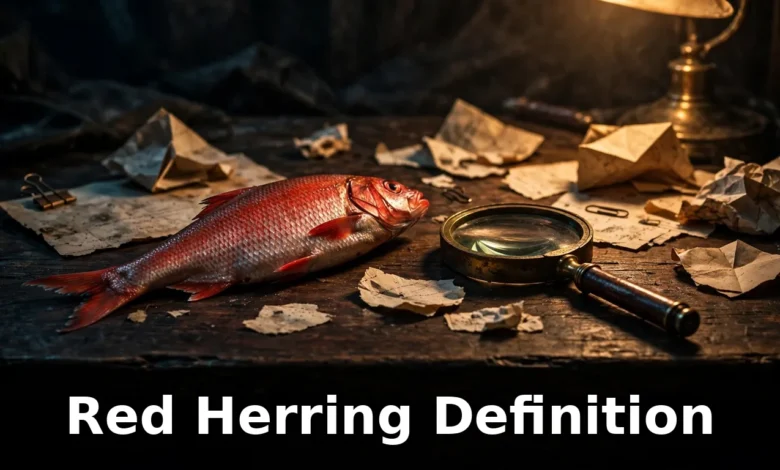
A red herring is a clue, detail, or argument that looks important but is actually designed — or happens — to lead you away from the real issue. It grabs your attention, sends you down the wrong path, and by the time you realise you have been distracted, the thing that actually mattered has slipped past you. That, in short, is the red herring definition.
You have probably met one without knowing its name. A detective novel throws suspicion on the quiet neighbour with the shady past, only for the real culprit to turn out to be someone else entirely. A politician, asked about a broken promise, starts talking passionately about something completely different. A friend, caught in a weak argument, suddenly brings up something you did three years ago. In each case, the red herring does the same job: it changes the subject while pretending not to.
The phrase itself is one of the most useful idioms in English, and it shows up everywhere — in crime fiction, in courtrooms, in classrooms, in everyday arguments, and in film and television. Once you know what to look for, you start seeing red herrings all over the place. This guide explains the red herring definition in plain language, traces where the expression came from, shows how writers and speakers use it, and gives you practical ways to spot one before it wastes your time.
More Information: How Do Meteor Showers Happen? A Simple Explanation
Red Herring Definition: What Is a Red Herring?
At its simplest, a red herring is a distraction. It is something that seems relevant to the question at hand but, on closer inspection, has nothing to do with it — or at least nothing that helps you reach the right answer. The distraction can be deliberate, like a writer planting a false suspect in a mystery, or accidental, like a conversation drifting off track because someone mentioned an emotional side issue.
The key word in the definition is misleading. A red herring is not just an irrelevant detail. Plenty of irrelevant details float around in any story or discussion, and most of them are harmless. A red herring is different because it actively pulls attention in the wrong direction. It looks like a lead. It feels like evidence. It demands a response. And while you are busy following it, the real point is left alone.
Think of it this way. Imagine you are trying to find out why your car will not start. A friend suggests it might be the battery, the starter motor, or the fuel pump — all sensible ideas. Then someone else says, “Well, you did leave the lights on last week, remember?” That is true, and it sounds relevant, but the lights were fixed days ago and the battery was tested since.
The comment drags the whole conversation back to last week, away from the actual fault today. That is a red herring: plausible, interesting, and entirely beside the point.
In writing, the term usually describes a plot device. An author introduces a character, an object, or a piece of evidence that points toward one conclusion, knowing full well the reader will chase it. The pleasure of a good mystery often comes from this trick — the reader feels clever for spotting the clue, then feels surprised when it turns out to mean nothing. In argument and debate, the term describes a logical fallacy: a speaker introduces an unrelated topic to avoid dealing with a difficult question or a weak position.
Both uses share the same core idea. A red herring is a detour dressed up as a shortcut. It promises progress and delivers delay.
Where Does the Term Come From?
The origin of “red herring” is one of those stories that sounds neat, gets repeated often, and is probably only partly true — which is fitting, in a way, for a phrase about misleading clues.
A herring is a fish. When herrings are smoked and cured, they turn a deep reddish-brown colour and develop a very strong smell. That smell is the heart of the story. The commonly told account goes like this: hunters and dog trainers in England would drag a smoked red herring across the ground to lay a false scent trail, training hounds to follow the real scent and ignore the distraction. Over time, the fish became a symbol for anything that throws someone off the scent — literally and then figuratively.
There is also a popular version involving fox hunting, in which a red herring was supposedly dragged across a fox’s trail to confuse the hounds. This version was popularised in the early 1800s by the journalist William Cobbett, who wrote about using a red herring to distract hounds.
Cobbett’s account is often quoted as the origin of the phrase, but language historians have pointed out that the expression was already in use before his writing, and that his story may have been more of a colourful illustration than a factual record of a common practice.
What we can say with more confidence is that the phrase was in print by the late 16th and early 17th centuries, used figuratively to mean a diversion or a false trail.
The exact moment it crossed from the world of smoked fish into everyday speech is lost, as it is with many idioms. The fishy explanation is the one most people accept, and it captures the meaning well: a strong smell that pulls you in the wrong direction.
There is a certain irony in the uncertainty. A phrase that means “a misleading clue” has a history full of misleading clues of its own. Scholars still debate the details, and that is worth remembering: when someone tells you the origin story with total certainty, they are probably smoothing over the gaps. The honest version is that the smoked-fish explanation is the best-known account, the hunting story helped spread it, and the precise first use is unclear.
Red Herrings in Mystery Stories and Films
Nowhere is the red herring more at home than in crime fiction. Mystery writers depend on it. Without false leads, a whodunit would be too easy — the reader would spot the culprit on page ten and the rest of the book would feel pointless. The red herring is what keeps the puzzle alive.
A classic example is the suspicious character. A novel introduces a man with a criminal record, a temper, and a motive, and places him near the scene of the crime. Every chapter adds another reason to suspect him. The reader becomes convinced. Then, near the end, the detective reveals that the man was somewhere else entirely, and the real killer was the quiet character nobody suspected. The suspicious man was never guilty — he was a red herring, planted to absorb the reader’s suspicion.
Films use the same trick visually. A camera lingers on an object — a letter, a weapon, a photograph — and the audience assumes it matters. A character behaves oddly in one scene, and viewers spend the next hour trying to explain it. Sometimes the detail pays off. Often it does not, and that is the point. The director wanted you looking there so you would not notice what was happening somewhere else in the frame.
Good writers use red herrings fairly. The best ones play by unwritten rules: the false lead should be plausible, it should fit the facts as the reader knows them, and the true answer should still be discoverable for a careful reader.
A cheap red herring, by contrast, simply lies to the reader or introduces a clue that could never have been solved. Readers can tell the difference, even if they cannot always name it. A fair red herring makes the reveal feel satisfying; an unfair one makes it feel like a trick.
Some of the most famous mysteries in English literature are built on this device. Agatha Christie was a master of it, filling her novels with characters who each seemed to have a reason to commit the crime. Arthur Conan Doyle used it in Sherlock Holmes stories, where Holmes himself often had to sort genuine evidence from noise. Modern crime dramas on television do the same thing across a whole season, introducing a new suspect every few episodes and letting the audience argue about each one.
The reason it works so well is that readers and viewers want to solve the puzzle. We are pattern-seeking creatures. Give us a detail that looks meaningful and we will build a theory around it, sometimes before we have enough evidence. The red herring exploits that instinct. It gives us something to be wrong about, and being wrong — when the story is well told — is part of the fun.
Red Herrings in Arguments and Debates
Outside fiction, the red herring is a logical fallacy — a flaw in reasoning that makes an argument weaker, even if it sounds convincing in the moment. It appears when someone responds to a point by raising a different issue, hoping the audience will follow the new topic and forget the original one.
Here is a simple example. A council is debating whether to repair a dangerous road junction. One speaker says, “We should fix the junction before someone is seriously hurt.” Another replies, “Well, what about all the potholes on the other side of town? Nobody ever talks about those.” The potholes might be a real problem, but they are not the question being debated. The second speaker has introduced a red herring — a genuine issue, used at the wrong moment, to avoid dealing with the junction.
Politicians use this move often, and so do advertisers, lawyers, and anyone under pressure in a difficult conversation. It is effective because it feels like engagement. The person is not refusing to answer; they are answering a different question, loudly and confidently, and hoping nobody notices the switch. In a live debate, with limited time and a watching audience, the switch often works.
It also shows up in personal arguments. A couple disagree about money, and one of them says, “You always do this — remember when you forgot my birthday?” The birthday may be a sore point, but it has nothing to do with the budget they were discussing. The conversation is now about an old hurt instead of the actual problem, and the budget question never gets answered. That is a red herring doing emotional work: it changes the subject to safer, or at least more familiar, ground.
Spotting this version of the fallacy is a useful life skill. The test is simple: does this new point actually address the claim that was made? If the answer is no, it does not matter how interesting or true the new point is. It is a distraction, and the honest response is to acknowledge it briefly and steer the conversation back. “That is a fair point, but it is a separate issue — can we finish this one first?” is usually enough.
It is worth adding that not every change of subject is a red herring. Sometimes a conversation genuinely needs to broaden, or a new point really does change the picture. The difference is relevance. A red herring looks relevant but is not. A legitimate new point actually connects to the original question and helps answer it. Learning to tell the two apart takes practice, and even experienced debaters get caught out.
Red Herring vs Straw Man and Other Fallacies
People often confuse a red herring with a straw man, and the confusion is understandable — both are ways of avoiding a real argument. But they work differently, and knowing the difference makes both easier to spot.
A straw man distorts the other person’s position and then attacks the distorted version. If you say, “We should spend a bit more on road safety,” and someone replies, “So you want to bankrupt the town and spend everything on roads?” — that is a straw man. Your position has been replaced with an exaggerated, easier target, and the reply attacks that instead. A red herring, by contrast, does not distort your position. It ignores it and talks about something else entirely.
Put side by side: the straw man fights a weaker version of your argument; the red herring walks away from your argument and starts a different conversation. Both are evasions, but the straw man at least pretends to engage with what you said, while the red herring changes the subject altogether.
There are other fallacies nearby that are worth distinguishing. An ad hominem attack targets the person instead of the argument — “You cannot trust her opinion on this; she failed the exam.” A red herring might include a personal remark, but its core move is topic-changing, not person-attacking. A false dichotomy pretends there are only two options when more exist — “Either we ban cars or accept the accidents.” That is a different error: it narrows the choices rather than changing the subject.
Another close relative is the appeal to emotion, which uses feelings to bypass reasoning. A speaker might describe a heartbreaking story to win support for a policy, and the story might be genuinely moving — but if it does not address whether the policy works, it is functioning as a red herring. Emotion is not the problem; the problem is when emotion replaces evidence on the actual question.
Why does the distinction matter? Because the right response depends on the move being made. Against a straw man, you correct the distortion: “That is not what I said — here is what I actually said.” Against a red herring, you redirect: “That is a different question — let us come back to the one we were discussing.” Using the wrong response wastes time and can make you look evasive yourself. Naming the fallacy correctly is not about winning points; it is about keeping the conversation honest.
More Information: Adidas Women’s VL Court Bold: Style, Fit and Where to Buy
Everyday Examples of Red Herrings
You do not need a courtroom or a crime novel to meet a red herring. They appear in ordinary life constantly, often in small ways that are easy to miss.
At work, a meeting about a missed deadline can drift into a long discussion about the software everyone dislikes. The software may indeed be bad, but the deadline was missed because the work was not scheduled properly, and the software discussion lets everyone avoid that uncomfortable fact. By the end of the meeting, people feel they have had a productive conversation, while the actual problem remains untouched.
In advertising, a red herring often takes the form of a flashy feature that distracts from a product’s weakness. A phone advertisement might focus on a dramatic camera feature while saying little about battery life, if battery life is the phone’s weak point. The camera feature is real and impressive — but it is there to pull your eye away from the thing the advertiser would rather you did not ask about.
In the news and on social media, red herrings appear as sensational side stories. A serious policy debate gets less attention than a celebrity comment about it, because the celebrity comment is more shareable and more fun to argue about. The substance of the policy fades while the noise around it grows. This is not always deliberate; the structure of social media rewards whatever grabs attention fastest, and a red herring grabs attention very well.
In school and study, students meet red herrings in exam questions. A question might include extra information that looks important but is not needed to reach the answer. Teachers include it deliberately, to test whether students can sort relevant facts from irrelevant ones. Learning to ignore the extra detail is part of learning the subject itself.
Even in everyday decision-making, red herrings appear. Someone choosing a car might become fixated on the colour or the sound system, while overlooking fuel costs or reliability. Someone choosing a holiday might focus on a single hotel review and ignore the overall pattern. The distracting detail is not meaningless — colour and sound systems do matter to the buyer — but when it takes over the decision, it stops the buyer from weighing the factors that will matter most in the long run.
The common thread in all of these is that the red herring is rarely a lie. It is usually something true, interesting, and emotionally engaging — and that is exactly why it works. A blatant lie is easy to reject. A true but irrelevant point is much harder to set aside, because dismissing it can feel rude or unfair.
Good critical thinking is not about ignoring true things; it is about asking, at the right moment, “True — but is it relevant here?”
How to Spot a Red Herring
Spotting a red herring is a skill, and like most skills it improves with practice. Here are some practical habits that help.
First, keep the original question in view. Before a discussion starts, or before you begin reading a mystery, be clear about what you are actually trying to find out. When a new point appears, ask yourself whether it brings you closer to that answer. If you cannot see the connection, say so — to yourself, at least — and hold the point aside until the main question is settled.
Second, watch for sudden topic changes, especially after a difficult question. A red herring often appears right after someone has been cornered. If a speaker was struggling and then suddenly becomes fluent and passionate about a new subject, that is a signal. Passion is not proof of relevance.
Third, notice emotional temperature. Red herrings often carry a charge — anger, nostalgia, pride, fear — that the original topic did not. The emotion is what makes the distraction sticky. If you find yourself suddenly feeling strongly about a point that came out of nowhere, pause and ask whether the feeling is doing the work that evidence should be doing.
Fourth, test the point on its own. Imagine removing the red herring entirely. Does the original question still stand, unanswered? If yes, the point was a distraction, however interesting. This test is especially useful in writing and in meetings, where a long detour can create the illusion of progress. A page of discussion that leaves the key question untouched is a page that achieved nothing, no matter how lively it was.
Fifth, be honest about your own red herrings. We all use them, often without realising it. When you catch yourself changing the subject in an argument — because the real point is uncomfortable, or because you do not have a good answer yet — that is worth noticing. Admitting “I don’t know” or “Let me think about that” is harder than reaching for a distraction, but it keeps the conversation honest and usually earns more respect in the long run.
Finally, remember that spotting a red herring is not the same as winning an argument. Pointing out the fallacy and then refusing to engage with the other person’s real concerns is its own kind of evasion. The goal is not to score points but to keep the discussion on the question that actually matters — and, once that question is answered, to give the side issue its fair hearing too, in its proper place.
Frequently Asked Questions
What is the red herring definition in simple terms?
A red herring is a misleading clue or piece of information that distracts you from the real issue. It looks important and relevant, but it leads you away from the correct answer or the main point of a discussion.
Is a red herring always deliberate?
No. In fiction, red herrings are usually deliberate — the writer plants them on purpose. In conversation, they are often accidental: someone raises a genuine but irrelevant point, or a discussion simply drifts. The effect is the same either way, but intent matters when you decide how to respond.
What is an example of a red herring in a story?
A common example is a mystery novel that makes one character look guilty — giving them a motive, a secret, and a suspicious alibi — only to reveal at the end that someone else committed the crime. The suspicious character was a red herring, there to mislead both the detective and the reader.
What is the difference between a red herring and a straw man?
A straw man distorts your argument into a weaker version and attacks that instead. A red herring ignores your argument and changes the subject to something else. Both avoid the real point, but they do it in different ways.
Can a red herring ever be useful?
In storytelling, yes — it is a legitimate and enjoyable device when used fairly, because it keeps the reader guessing. In argument, it is generally unhelpful, because it prevents the real question from being answered. The context decides whether the distraction is a craft or a flaw.
Conclusion
By the red herring definition, it is a small thing with a large effect: a detail, a clue, or a remark that pulls you off track while looking like it is helping you forward. It comes from the world of smoked fish and hunting dogs, grew into a favourite device of mystery writers, and now names one of the most common flaws in everyday reasoning. Knowing the term does not make you immune to the trick — good red herrings fool careful people too — but it does give you a name for what is happening and a way to respond.
The next time a conversation, a story, or a sales pitch suddenly changes direction, ask the simple question that cuts through it: is this actually relevant, or is it a red herring?
Read Also: Part of Your World Lyrics: Meaning and Full Song Guide