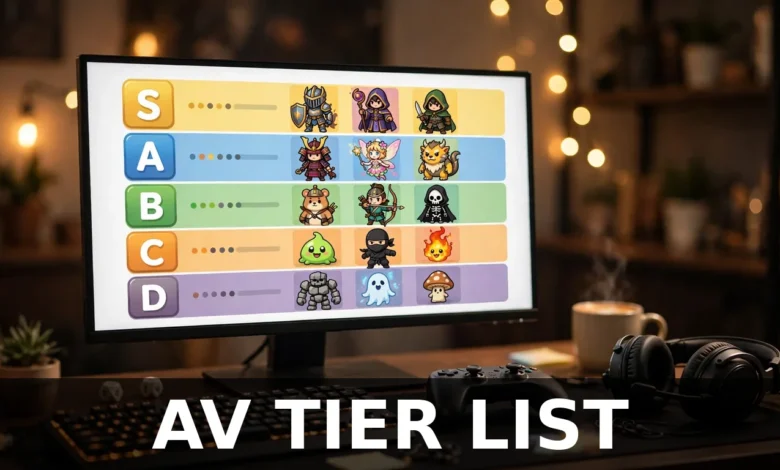
If you spend any time on gaming forums, social media, or fan communities, you have almost certainly come across a tier list. A single image, a row of letters from S down to D, and a long line of names or faces sorted into boxes. The phrase “AV tier list” shows up in the same places, and it confuses a lot of people, because those two little letters can mean different things depending on who made the list.
This guide explains exactly what an AV tier list is, what the letters mean, where these lists come from, and how to read one without taking it as gospel. It also shows you how to build your own, whether you want to rank game characters, gadgets, movies, or anything else.
What Is an AV Tier List?
An AV tier list is a ranking chart that sorts a set of items into tiers, usually labelled S, A, B, C, and D, from best to worst. The letters stand for the quality or strength of each item according to the person who made the list. Items in the S tier are considered the best of the best. Items in the D tier sit at the bottom.
The “AV” part of the phrase is where things get interesting. In most cases, AV is short for “audio-visual,” and an AV tier list ranks audio-visual products or media — headphones, speakers, televisions, cameras, or video content. In other corners of the internet, AV refers to something else entirely, and the list ranks performers or titles in that field. The format is always the same; only the subject changes.
A tier list is not an official chart. It is one person’s opinion, or one community’s collective opinion, presented in a visual format that is easy to scan. That is exactly why the format became so popular. A reader can understand the whole ranking in about five seconds, then spend the next hour arguing about it in the comments.
What Does “AV” Stand For?
The abbreviation AV has more than one meaning, and the meaning decides what the tier list is actually ranking. Here are the most common ones you will run into.
Audio-Visual
This is the most common meaning. AV covers anything that combines sound and picture: televisions, monitors, headphones, speakers, soundbars, projectors, cameras, and streaming devices. An AV tier list in this sense ranks products by picture quality, sound quality, features, and value for money. Tech reviewers and home-theatre communities publish these lists when new models arrive, and buyers use them as a shortcut before spending money.
Adult Video
In Japan, AV is the standard abbreviation for adult video, and the Japanese adult entertainment industry is large enough that its fans make tier lists ranking performers and studios. These lists circulate on forums and social media, usually sorted by popularity, performance, or longevity. They are the reason many people searching for the phrase land on very different results from what they expected.
Other Uses
In gaming communities, AV sometimes appears as shorthand inside a game’s own vocabulary, for example a character, a faction, or a mode whose initials happen to be A and V. In that case the tier list ranks whatever the game community cares about — characters, weapons, or strategies — and the AV label only makes sense inside that community.
The lesson is simple: before you trust an AV tier list, check what AV means on that particular list. The letters on the left stay the same, but the subject can change completely.
How Tier Lists Work: S, A, B, C, and D Explained
Every tier list uses the same basic structure, borrowed from Japanese video game ranking systems. The tiers run from best to worst, and each one has a clear job.
| Tier | Meaning | What lands here |
|---|---|---|
| S | Superb — the best available | The top picks, the ones people recommend without hesitation |
| A | Excellent — very strong | Great options with only small flaws |
| B | Good — solid and reliable | Dependable choices that do the job well |
| C | Average — usable but limited | Acceptable, but there are better options nearby |
| D | Weak — hard to recommend | The bottom of the list, picked only in special cases |
| F | Fail — avoid | Items that are broken, outdated, or poor value |
Some lists add extra tiers. An S+ tier sits above S for the single best item of all. An E or F tier appears at the bottom for the worst entries. Some creators use a “meme tier” or a “do not use” tier for items that are so bad they are funny. The exact labels matter less than the order: the higher the letter, the stronger the ranking.
The power of the format is its simplicity. Instead of reading a 3,000-word review of twenty products, you look at one image and see immediately which three products are worth your attention and which five you can ignore.
Where You Will See AV Tier Lists
Tier lists have spread far beyond their gaming origins. Here are the places the format shows up most often.
Gaming
This is where the tier list was born. Fighting games ranked characters by competitive strength, and the idea spread to every other genre. Today you will find tier lists for heroes in team shooters, weapons in battle royale games, cards in trading card games, and units in strategy games. Competitive players treat these lists seriously, because a character’s tier can decide whether they are picked in a tournament.
Anime and Manga
Anime fans rank characters, opening songs, story arcs, and even whole series. These lists are almost entirely about personal taste, which is why they generate the longest arguments. A character one fan places in S tier is another fan’s C tier, and both sides will happily explain why the other is wrong.
Music and Movies
Music fans rank albums, songs, and artists. Movie fans rank films in a franchise from best to worst. These lists work well because everyone has seen or heard the same material, so the debate is about taste rather than facts.
Technology and Audio-Visual Gear
Tech communities rank headphones by sound quality, televisions by picture quality, and cameras by value. These lists are more useful than most, because they are usually built on measurable qualities such as battery life, resolution, or frequency response, and the author often explains the reasoning behind each placement.
Japanese AV Performer Rankings
Ranking lists for performers in Japan’s adult video industry are common on fan forums. They are usually sorted by popularity, career length, or recent work, and they change often as new performers debut and older ones retire. Because these lists are fan-made, they reflect the tastes of a specific community rather than any official standing.
How to Read an AV Tier List Without Being Misled
A tier list looks authoritative. It is a clean chart, it uses letters like grades, and it often comes from someone who sounds confident. That does not make it accurate. Keep these points in mind before you trust one.
Check Who Made It
A list made by a professional reviewer who tested every product is worth more than a list made by a fan who owns one of them. Look for the author’s name, their experience, and whether they explain their method. If there is no explanation at all, treat the list as entertainment, not advice.
Look for the Criteria
A good tier list tells you what it is ranking and how. Is it ranking pure performance, or value for money? Is it ranking characters for casual play or for professional tournaments? The same item can sit in S tier under one set of rules and C tier under another. If the criteria are missing, the ranking is just a guess dressed up as data.
Watch Out for Popularity Bias
Items that are new or heavily promoted often land in a higher tier than they deserve, simply because everyone is talking about them. Items that are old or unfashionable sink, even when they still perform well. A list made in the week a product launches is often revised a month later, once the excitement fades.
Remember That Tiers Are Relative
An item in B tier is not bad. It is simply worse than the items in A and S tiers on that list. In a list of twenty excellent products, the B tier products may still be very good. The letter describes the item’s position relative to the others on the list, not its absolute quality.
Check the Date
Tier lists go out of date fast. A new update, a price cut, or a new release can move an item up or down by two tiers overnight. A tier list from last year may be useless today. Always check when the list was published or last updated.
How to Make Your Own AV Tier List
Making a tier list is easy, and doing it well is a useful exercise. It forces you to decide what actually matters and to compare things honestly instead of relying on gut feeling.
Step 1: Decide What You Are Ranking
Pick one clear category. Do not mix headphones with televisions, or game characters with movies. The items on a list must be comparable, or the ranking means nothing.
Step 2: Choose Your Criteria
Write down two to five criteria before you start ranking. For products, that might be quality, features, price, and reliability. For characters, it might be strength, versatility, and ease of use. Your criteria are the rules of your list, and they keep you honest when your favourites are involved.
Step 3: Gather Your Items
List every item you want to rank. Include the popular ones, the unpopular ones, and the ones you personally dislike. A list that only includes your favourites is not a ranking; it is a fan poster.
Step 4: Score Each Item
Give each item a rough score against your criteria. You do not need a spreadsheet, but a simple score out of ten for each criterion makes the final sorting much easier and much fairer.
Step 5: Sort Into Tiers
Place the highest scorers in S tier and work downward. Try to keep S tier small. If half your items are in S tier, your tiers have lost their meaning. A good rule is that S tier should hold roughly the top ten percent of the list.
Step 6: Write a Short Reason for Each Tier
One or two sentences per tier is enough. Explain what the items in that tier have in common and why they sit where they do. This is the part most list-makers skip, and it is the part that makes a list useful to anyone else.
Step 7: Update It
Revisit the list when something changes. A new release, a price drop, or a software update can change a ranking. A list that is never updated slowly turns into misinformation.
What Makes a Good Tier List
Not all tier lists are equal. The best ones share a few qualities that are easy to spot.
Clear criteria. The author says what is being ranked and how. You can disagree with the criteria, but you can see them.
Complete coverage. The list includes every relevant item, not just the ones the author likes. Missing items are usually the sign of a rushed or biased list.
Honest S tier. The top tier is small. When everything is S tier, nothing is.
Explanations. Each placement has a reason, even a short one. A list with no reasons is a picture, not an argument.
A date. The reader can tell whether the list is current. A tier list without a date should be treated with suspicion.
Room for disagreement. A good list-maker admits that some placements are close calls. The difference between the bottom of A tier and the top of B tier is often tiny, and pretending otherwise is dishonest.
Common Mistakes in Tier Lists
Even popular lists get things wrong. Here are the mistakes that show up most often.
Ranking by popularity instead of quality. The most talked-about item is not automatically the best. Popularity measures attention, not performance.
Ignoring price. A product that costs three times as much as its rival should be three times better to earn the same tier. Lists that ignore price mislead buyers.
Tiny sample sizes. A list built from one person’s experience with three of the twenty items is a guess, not a ranking.
Refusing to update. Creators get attached to their first version and ignore new evidence. A list that never changes is a list that is slowly going wrong.
Mixing categories. Ranking a budget product against a premium one on pure performance, without noting the price gap, produces a chart that punishes good cheap products for not being expensive.
AV Tier Lists and Search: Why the Phrase Is Confusing
Search results for “AV tier list” are messy, and there is a reason for that. The phrase combines a short abbreviation with a generic format, so search engines return a mix of gaming lists, tech rankings, anime character charts, and adult industry lists. Two people typing the same phrase can be looking for completely different things.
If you are searching for one, add a word that narrows it down. “AV tier list headphones” will bring up audio gear rankings. “AV tier list anime” will bring up character rankings. “AV tier list gaming” will bring up game rankings. The extra word costs you one second and saves you from scrolling through results you never wanted.
Frequently Asked Questions
What does S tier mean in a tier list?
S tier is the highest rank on a tier list. The letter S comes from Japanese grading systems, where S stands for “superb” or “special” and sits above A. Items in S tier are considered the best available in the category being ranked.
Is an AV tier list official?
No. Almost all tier lists are made by fans, reviewers, or communities. There is no official body that publishes tier lists. Treat them as informed opinion, not as a final verdict.
What is the difference between S tier and A tier?
The gap is usually small. S tier items are the best of the best, while A tier items are excellent with only minor flaws. In practice, the difference between the bottom of S tier and the top of A tier is often a matter of taste.
Can a tier list change over time?
Yes, and good ones do. New releases, price changes, software updates, and balance patches can all move items between tiers. A tier list that is more than a few months old should be checked against a newer one before you rely on it.
Where can I make my own tier list?
Several free websites let you build tier lists by dragging images into rows. You upload or select images for each item, label your tiers, and export the finished chart as an image. These tools are the reason the format spread so fast: anyone can make one in ten minutes.
Why do people argue about tier lists so much?
Because a tier list turns a matter of taste into something that looks like a fact. A chart with letters and boxes feels objective, so people defend their placements as if they were scientific results. In truth, most tier lists mix measurable facts with personal preference, and that mixture is what keeps the arguments going.
Conclusion
An AV tier list is a simple tool: a set of items sorted into tiers from S to D, with AV telling you what kind of items are being ranked. The format is popular because it is fast to read and easy to argue about, and it is useful when the author explains their criteria, covers the whole category, and keeps the list up to date.
The next time you see one, do not just look at the letters. Ask who made it, what they were measuring, and when they made it. A tier list is only as good as the thinking behind it, and the best way to understand a ranking is to try making one yourself. You will quickly learn how hard it is to be fair, how much your own taste creeps in, and why two honest people can produce two completely different charts from the same items.
Read Also: Directions to Workplace: Easy Ways to Find Your Office