History is often taught from a textbook, and for many students that means dates to memorise and chapters to get through. Mission US takes a different approach. It drops the player into the middle of a moment in American history and asks them to live through it, making the same kinds of choices a real person of that time would have faced.
The result is a series of free online role-playing games that has become one of the most widely used history resources in American classrooms. Millions of students have played it, and more than 140,000 teachers have registered to use it. This guide explains what Mission US is, how it works, what each mission covers, and how to get the most out of it.
What Is Mission US?
Mission US is a free series of interactive adventure games that teach American history by putting the player in the role of a young person living through a turning point in the nation’s past. It was developed for use in middle school and high school classrooms, and each mission pairs a playable game with curriculum materials for teachers.
The project is produced by The WNET Group, New York’s public media organisation, in partnership with historians at the American Social History Project and the Center for Media and Learning at the City University of New York. The games themselves were built by the studio Electric Funstuff. Major funding has come from the Corporation for Public Broadcasting, with additional support from the National Endowment for the Humanities and the United States Department of Education.
The series began in 2008 with a simple idea: make American history more engaging and easier to grasp for middle school students. Since then it has grown into the most widely played history game in American schools, with more than five million registered users. It is free to play in a web browser, and the teaching materials that go with each game are free as well.
What makes Mission US different from a history quiz or a documentary is that the player does not just learn about a period. They make decisions inside it. Those decisions have consequences in the game, and the game pauses to explain why a choice mattered. That combination of story, choice, and reflection is the heart of the whole project.
The Eight Missions
Each mission is a self-contained game set in a different era. Together they cover more than two centuries of American history, from the years before the Revolution to the civil rights movement.
| Mission | Setting | You play as |
|---|---|---|
| For Crown or Colony? | Boston, 1770 | Nat Wheeler, a 14-year-old printer’s apprentice |
| Flight to Freedom | Kentucky and Ohio, 1848-1849 | Lucy King, a 14-year-old enslaved girl |
| A Cheyenne Odyssey | The Great Plains, 1866-1876 | Little Fox, a young Northern Cheyenne boy |
| City of Immigrants | New York City, 1907 | Lena Brodsky, a young Jewish immigrant |
| Up from the Dust | The Texas Panhandle, 1929-1936 | Frank and Ginny Dunn, twins on a farm in the Dust Bowl |
| Prisoner in My Homeland | California, 1941-1945 | Henry Tanaka, a 16-year-old Japanese American |
| No Turning Back | Mississippi, 1960s | Verna Baker, a young Black woman in the civil rights movement |
| Spirit of a Nation | Florida, 1500s-1700s | Members of the Apalachee, an Indigenous people of northwestern Florida |
For Crown or Colony?
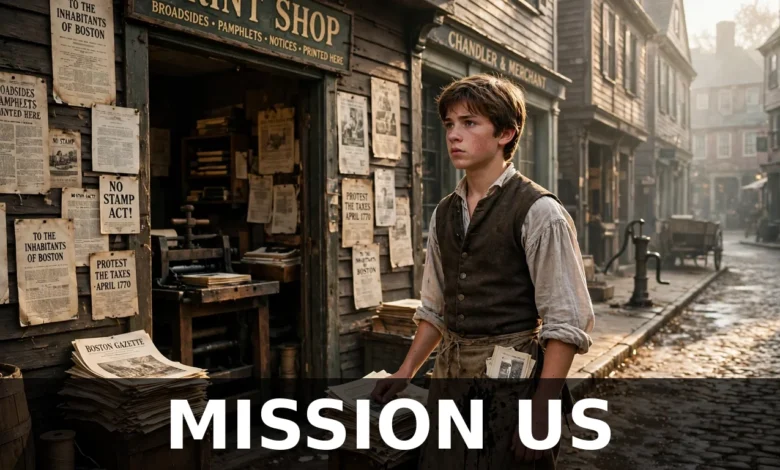
The first mission, released in 2010, puts the player in Boston in 1770, in the years leading up to the American Revolution. Nat Wheeler is a fourteen-year-old printer’s apprentice whose master is a Patriot, while his family leans Loyalist. The player has to navigate both sides of a town splitting apart, and the story builds toward the Boston Massacre. The mission teaches how ordinary people were pulled into a political conflict they did not start, and how the Revolution looked different depending on whose side you were on.
Flight to Freedom
The second mission, released in 2012, follows Lucy King, a fourteen-year-old enslaved girl on a Kentucky plantation in 1848. The player guides Lucy as she weighs the risks of escaping to freedom in Ohio, learning how enslaved people resisted, how the Underground Railroad worked, and how the law treated people who tried to run. It is widely considered the most powerful mission in the series, and it has been praised for handling a difficult subject with honesty rather than softening it.
A Cheyenne Odyssey
The third mission follows Little Fox, a young Northern Cheyenne boy, across the Great Plains in the years 1866 to 1876. The player experiences the pressures of westward expansion from the Native perspective: broken treaties, the disappearance of the buffalo, and the final conflicts of the Plains Wars. It is one of the few classroom resources that tells the story of westward expansion from the side of the people who were displaced by it.
City of Immigrants
The fourth mission is set in New York City in 1907. Lena Brodsky, a young Jewish immigrant from Russia, arrives at Ellis Island and has to build a new life in the Lower East Side. The player deals with tenement housing, sweatshop work, and the pull between old traditions and a new country. The mission covers immigration, urban life, and the Progressive Era in one story.
Up from the Dust
The fifth mission follows Frank and Ginny Dunn, twins growing up on a farm in the Texas Panhandle during the Great Depression and the Dust Bowl. The player manages the family’s farm through drought, dust storms, and falling prices, making decisions about crops, money, and whether to stay or leave. It teaches the economics of the Depression through the experience of one family trying to survive it.
Prisoner in My Homeland
The sixth mission covers the incarceration of Japanese Americans during the Second World War. Henry Tanaka is a sixteen-year-old whose family is forced from their home in California into a camp. The player experiences the loss of home, the questions of loyalty and identity, and daily life behind barbed wire. It is a subject many textbooks cover in a paragraph; this mission gives it a full story.
No Turning Back
The seventh mission is set in Mississippi during the civil rights movement of the 1960s. Verna Baker, a young Black woman, joins the movement and faces the dangers of voter registration drives, segregated public spaces, and violent resistance. The mission shows how the movement worked at the local level, through ordinary people taking extraordinary risks.
Spirit of a Nation
The eighth and newest mission, released in early 2025, tells the story of the Apalachee, an Indigenous people of northwestern Florida, across the centuries of first contact with Europeans. It covers conflict, adaptation, and cultural persistence, and it shows how Indigenous communities survived encounters that textbooks often present as a simple story of disappearance. The mission includes an introduction, three interactive lessons of about twenty minutes each, and a conclusion.
How the Games Work
Each mission follows the same basic structure, which is designed to fit into classroom time while still feeling like a real game.
Role-playing, not lecturing. The player controls a character and makes choices for them. Do you speak up in a meeting, or stay quiet? Do you trust this person, or walk away? The game shows the result of each choice, and the story branches accordingly.
Short sessions. Each mission is divided into parts that take about twenty to thirty minutes each. A full mission takes a few hours spread over several class periods. Teachers can stop at natural breaks and pick up where they left off.
Decision points with reflection. At key moments the game pauses and asks the player to think about why they chose what they chose. These reflection points are where the learning happens. The game does not just reward the “right” answer; it explains the thinking behind different options.
Historical documents. Each mission includes real documents from the period: letters, newspaper articles, posters, and photographs. Players examine these documents as part of the story, which builds the same skills historians use.
A sense of consequence. Bad choices in Mission US do not just lose points. They can change the story in serious ways, including endings where the character fails. That makes the choices feel real, and it teaches something a textbook cannot: that historical outcomes were not inevitable, and that the people living through them did not know how things would turn out.
Who Is Mission US For?
The games were designed for students in grades five to nine, roughly ages ten to fifteen. That is the sweet spot: old enough to handle serious subjects, young enough to enjoy a game. In practice, the audience is wider than that.
Students. Middle school and high school students are the main players. The games work as an introduction to a topic, as a way to review material, or as a standalone activity during a history unit.
Teachers. More than 140,000 teachers have registered. Each mission comes with an educator guide that includes lesson plans, discussion questions, vocabulary, background readings, and document-based activities. The guides are aligned to national standards, which makes it easy to fit the games into an existing curriculum.
Homeschooling families. Because the games and the guides are free, homeschooling parents use Mission US as a complete history activity. The games are self-contained enough that a student can play one with minimal supervision, and the guides give parents discussion material.
Anyone curious about American history. Adults play the games too. The writing and the historical detail are good enough that the missions work as an introduction to their subjects for any age.
How to Play Mission US
Playing is simple, and it costs nothing.
Create a free account. Go to the Mission US website and register. A free account saves your progress, so you can stop in the middle of a mission and return later. Teachers can create accounts for their classes and track student progress.
Pick a mission. There is no required order. You can start with whichever period interests you, or whichever one matches the topic you are studying. Most people start with For Crown or Colony?, the first mission, but any of the eight works on its own.
Play in a browser. The games run in a web browser on a computer, tablet, or Chromebook. There is nothing to download and nothing to install, which is one reason schools adopted it so quickly.
Use the educator guides. If you are a teacher, download the guide for the mission you are using. It includes a curriculum overview, an implementation guide, reflection questions, and activities that extend the game into writing and discussion.
Talk about it afterwards. The game is only half the experience. The reflection questions and class discussions are where students connect the story to the bigger historical picture. A mission played without discussion is still fun, but it teaches less.
Mission US in the Classroom
Teachers use Mission US in several different ways, and the project’s own research suggests the approach works.
As an introduction. A teacher starts a unit by letting students play the first part of a mission. The game gives students a feel for the period before they read about it, which makes the reading easier to follow.
As the core activity. Some teachers build a whole unit around a mission, alternating game sessions with document analysis and discussion. The educator guides are built for exactly this pattern.
As a review. After teaching a topic the traditional way, a teacher uses a mission to let students apply what they have learned. The choices in the game test understanding in a way a quiz cannot.
For differentiation. The games work for students at different reading levels, because the story carries the learning. Stronger readers can dig into the documents; students who struggle with text can still follow the story and take part in the discussion.
An efficacy study funded by the Institute of Education Sciences looked at whether the games actually improve students’ knowledge and motivation. The project has been running long enough, and has been used by enough teachers, that it has become a standard reference point in discussions about games in education.
Strengths and Limitations
No teaching tool is perfect, and Mission US is honest about what it is and what it is not.
Strengths
It is free. There is no cost for the games or the teaching materials. That matters for schools with tight budgets.
It is historically careful. Historians worked on every mission. The characters are fictional, but the events, the settings, and the choices are grounded in real history.
It teaches perspective. Each mission shows history from the point of view of someone who lived it, including people whose stories rarely appear in textbooks: an enslaved girl, a Cheyenne boy, a Japanese American teenager, a young immigrant.
It builds real skills. The document activities teach students to read primary sources, weigh evidence, and form arguments, which are the core skills of history as a subject.
Limitations
It is simplified. A game cannot capture the full complexity of a historical period. Teachers need to fill in the gaps with reading and discussion, or students may come away with a story that is true but incomplete.
The graphics are modest. Mission US was built on a classroom budget, not a game-studio budget. Students used to modern games will notice the difference. The story has to carry the experience, and for most students it does.
It only covers American history. The series is about the United States. Teachers looking for world history games will need to look elsewhere.
It needs a teacher, or at least a conversation. The games are better with discussion. A student playing alone gets the story, but some of the learning depends on the reflection questions that follow.
Mission US vs Other History Games
History games are not new, but most of them fall into two groups: big commercial games that treat history as a setting for combat, and quiz apps that treat history as a list of facts to memorise. Mission US sits in a different place.
Commercial strategy games let you rewrite history, which is fun but teaches little about what actually happened. Quiz apps test recall, which is useful but shallow. Mission US keeps the player inside real events, limits their choices to ones a person of that time could actually have made, and then explains the consequences. It is closer to an interactive novel than to either a strategy game or a quiz, and that is why it works in a classroom where the others mostly do not.
Frequently Asked Questions
Is Mission US really free?
Yes. The games and the educator guides are free to use. The project is funded by public broadcasting grants and education funding, not by charging players. You need a free account to save progress, but there is no paid version and no in-app purchases.
What age is Mission US for?
It is designed for grades five to nine, roughly ages ten to fifteen. Younger students may find some subjects, particularly Flight to Freedom, too heavy. Older students and adults can still enjoy the stories and learn from them.
How long does a mission take to finish?
Each mission takes a few hours in total, split into parts of about twenty to thirty minutes. A teacher usually spreads one mission over several class periods.
Do you need to download anything to play Mission US?
No. The games run in a web browser. You need an internet connection and a free account to save your progress.
Can Mission US be used at home?
Yes. Anyone can create a free account and play. Homeschooling families use the games with the educator guides, which are also free to download.
Is Mission US historically accurate?
The characters are fictional, but the events, settings, and situations are based on real history and were developed with historians. The games simplify some things for playability, so they work best alongside other reading, not as a student’s only source.
Which mission should I start with?
Start with the period that interests you most, or the one that matches what you are studying. For Crown or Colony? is the natural starting point if you want to go in order, and Flight to Freedom is often recommended as the strongest single mission.
Conclusion
Mission US proves that a history lesson does not have to feel like a lesson. By putting the player inside a story and letting them make the choices, it turns abstract dates and events into something personal. A student who has guided Lucy King toward freedom, or helped the Dunn twins keep their farm through the Dust Bowl, understands those periods in a way that reading a chapter alone rarely achieves.
It is free, it is built with historians, it comes with proper teaching materials, and it has been played by millions of students. If you teach American history, or you are studying it, or you are simply curious about it, it is worth a few hours of your time. Start with one mission, play it through, and then talk about the choices you made. That conversation is where the real learning happens.
Read Also: AV Tier List: What It Means and How Rankings Work (2026 Guide)